As my chess mysteriously worsens I have started not to think in terms of wins and losses, but to steer towards interesting struggles on which I can blog. I prefer writing to chess anyways, if only because putting pen to paper allows a more controlled expression outlet. My mind is my own fiefdom, but in chess I have to account for the goals of the impresario across from me, or at the other end of a long and winding fiber-optic cable .
This change in perception comes on the heels of my realization that I am near the zenith of where I will go in chess. Being 1500-something and having an irreverent blog is not the worst one can do in what is, after all, a game. I can almost picture old Semyon from Chekhov’s “In Exile” saying “Everyone should have such a life!”
To fulfill my desire for better games I have been seeking players much higher than my strength. The opponent who pummeled me in this instance had a rating of about 1600 USCF. I am white.
Another Semi-Slav with Bg4. Could this time be different?
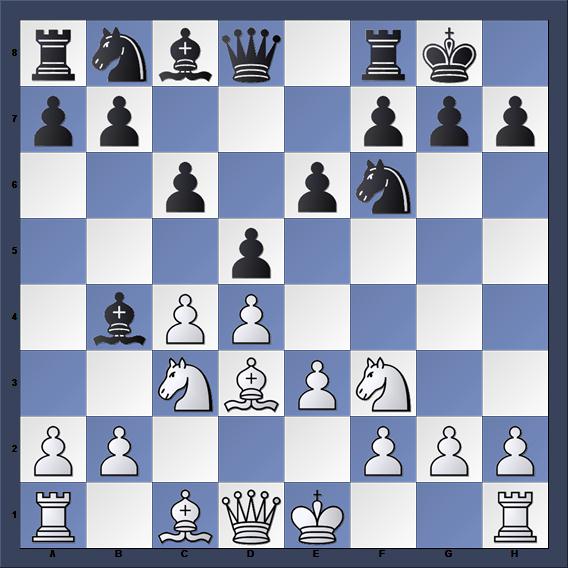
7. O-O a5: What does this move do? It’s different than dxc4, b6, Nd7, or Qc7 because it ignores the center. If it doesn’t assist in development or impact the center at least indirectly it’s usually a bad move. My plans should focus on seizing space and indeed they do.
8. Qe2 dxc4 9. Bxc4 b5 10. Bd3 Nbd7 11. e4 Bb7
White Seizes the Center
Black plays 11…Bb7 here. Look at the position. White has played mistake-free chess. Everything that has happened thus far is preparation for the moves to come. However to retain the initiative white has to play quite carefully. Black has no long-term problems and if white cannot put pressure on him the second player’s position will be fine. In other words white has no static advantages. Space is purely a dynamic advantage, and like a carton of milk it turns bad if you don’t use it.
Fritz has been kind of enough to point the way to victory with a red arrow.
12 Bg5 is simply a chess move and nothing more. It develops safely but is not part of a concrete plan to make the most of my assets in the position. Interesting enough I looked at the natural e5 and dismissed it.
Here is what I saw:
e5, Nd5, Nxcd5, cxd5 unclear (white actually wins a pawn)
e5, Nd5, Nxcd5, exd5 (the conditions are ripe for a classic bishop sacrifice on h7)
e5 Ne8 (Not considered)
e5 Nh5 (I don’t have a means to tactically punish the knight and I’ve made black’s bishop stronger)
frustration at not having a concrete continuation takes over at this point
White has the ability to gain long-term initiative in driving away a key defender of the king. Perhaps by pushing the pawn forward does lead to an inferior endgame against sound defense. So flippin’ what? I’m white. So next time I have to play like it.
The rest of the game is interesting and has a few unique features. It’s worth playing through if only to examine the merit of the exchange sacrifice near the end.