Chess playing & society

The effects of chess playing in social situations and how it can improve society.

A Faux War is no War

I’d like to discuss the popular use of warfare comparisons to games, chess in particular. Fischer was a fan of such analogies and I suspect that this is the source of such phrases’ popularity in the chess world. Just know that your carelessness makes you sound as ridiculous as this. I can’t agree with you here Big Ticket! When I play chess I don’t go into combat with children, the elderly, and the infirm. If you feel that your next chess antagonist is your enemy, I’d say the potential for checkmate is not your biggest problem.

When you atomize the chess-warfare comparison, using it without regard for its consequences, you get something mind-numbing. If chess is war, then it’s acceptable when 7/8 of your army dies. As long as you win, your Pyrrhic victories still net you a rating bump. I get called out by my chess coach when I do not sacrifice enough material. The easiness of such an analogy means we must be ever on our guard.

Comparing a pastime to war breaks down the distinction of the latter as something primal and ugly. War must remain a thing apart from everything else. It’s not to say that it should completely leave our consciousness, but it cannot be fun while remaining an option of last resort. The victims of our little language breakdown include a sitting U.S president himself.

Lost in a boyhood fantasy, one erstwhile GOP leader decided to tip over a “king.” It’s instructive to look at his language, as well as that of the military high command, from 2003-2008. You’ll find plenty of language that sounds suspiciously like the type chess players use without thinking. Don’t “tactical shot”, “psy-ops”, and “smoke ’em out” speak of something dark and deep? Let’s not encourage their use without true context.

I haven’t charged any machine gun nests, stormed houses, or held a bridge by my lonesome; I only served with people who did. Most, not all, came back thanks to advances in battlefield medicine and technology. But none returned quite as they left.

Veterans hate war analogies because we never want you to experience life as we have. The human animus is often dark and people die because of that darkness. The point of our going overseas is so we can make your comparisons baseless. Let us do that so you can play your games.

Back to veteran’s hospitals, they have them (under different names) in all developed countries. You ought to stop by sometime to see what truly happens to your nation’s soldiers when they get put back in the box.
 

Anand vs. the World

Vishy Anand won the 2012 Chess World Championship and already ranks among the strongest players of all time. The chess community knows him as a fantastically consistent competitor. This is due in part to his excellent preparation, evidenced by the stellar match record he holds. Recently he agreed to a game on Chess.com billed as “Anand vs. the World.” It was so-called vote chess wherein the power of a crowd is harnessed against a true star of the sport.

Unfortunately I looked at the game only afterwards; I think watching games live is a very instructive way to think about developing one’s game, and I’m quite sorry I didn’t get to be on the world’s team. You don’t really take in a sport just from a box score or a sheet of notation.

The drawn game provided a favorable result for the unwashed multitudes, since you don’t simply arrive at a group’s rating total by adding up their points – you also bring into the fold each member’s bad form. Sometimes a group is less than the sum of its parts; the American Legislature for instance has 535 participants, and together its members produce little more than spleen-filled bluster .So here is how the group acquitted themselves.

1. d4 d5 2. Nf3 Nf6 3. c4 c6 4. Nc3 e6 5. e3 Bb4 6. Bd3 O-O 7. O-O Nbd7 8. a3 {
Think back to Bb4. White’s pawns will now be doubled. While it seems easy to
trade off one of them for the d-pawn the recapture with the e-pawn allows a
Carlsbad Structure without white’s normal piece activity. His knight is also
on f3 rather than e2. While the bishop remains in position it indirectly
relieves pressure on the d-pawn.} Bxc3 9. bxc3 Qc7 10. a4 {I don’t truly
understand this move. Black’s b5 push is pretty standard. Perhaps Anand just
did not want to play those complicated Meran Lines without a prize on the line.
The last thing you want to do is give away a novelty in a game of skittles
chess.} e5 {Black can get in his important break.} 11. Nd2 e4 {Black’s bishop
problem is solved and he is not worse.} 12. Be2 {Without looking ahead ask
yourself if you would capture on d5 with a pawn or a piece. They’re both
reasonable tries, with objective evaluations closely resembling one another.
They lead to different play however.} Re8 13. Ba3 Nb6 14. c5 Nbd7 15. c4 Nf8
16. Rb1 Ng6 {Black has plenty of space. At least four pieces will vie for
white’s king. It’s not so easy to come to the defense. White’s avenues are
quite closed on the queen wing.} 17. Qb3 Rb8 18. Rfc1 Bg4 19. Bf1 Be6 20. Be2
Bg4 21. Bf1 Be6 22. Be2 Bg4 {There were other moves for both sides. Qd1 for
white and Ng4 for black would have kept the game level.} 1/2-1/2


The Will to Win

I saw a black cat eating grass the other day during a drive through Philadelphia. I looked into its lantern eyes and there wasn’t a trace of contempt; it was thankfully rooting shoots up from the ground even as our stoplight turned from red to green. I hope that on those days that I’m spiritually reduced to such bare-earth clawing, that I can muster such equanimity.

Humans in dire straits often become aloof, and cling to old notions of how things should be; we design a future world based on the glory of our own antiquity. Sometimes we should instead rework our own ideas to achieve something practical. I’ve volunteered in homeless shelters where I’ve found patrons refusing to eat the food given them. Someday there will be an end of the world, both of our own private life and society’s at large, but until then no situation is so terrible; play out your private drama. It is the only thing that’s yours alone.

Since I know you’re above such sincere gestures as gnawing at festuca, maybe we can start with something smaller. When you find most of your pieces consigned to an opponent, don’t concede. Muster what you have in the best way you know how. If you feel hopelessness, ignore it; if you feel angry, banish it; if you feel ashamed of being ground down, enjoy the perfect freedom of facing an insuperable difficulty.

Everyone loses, but in a chess match you get to do so slowly, with plenty of time to sit and understand. Many of our difficulties in life, by contrast, engulf us completely and in the swirl of one moment. These tough times offer little to make us immediately mindful. I like to sit being a queen down and learn a little bit more about who I am. I like the knowing, sad-eyed spectators. I’ll see them in the lobby, in about three hours, with a wonderful story!

I’d like to present a beautiful game that reinforces my idea.

Evans – Reshevsky (1963) “The Swindle of the Century”

1. d4 Nf6 2. c4 e6 3. Nc3 Bb4 4. e3 c5 5. Bd3 O-O 6. Nf3 d5 7. O-O dxc4 8. Bxc4
Nbd7 9. Qe2 a6 10. a3 cxd4 11. axb4 dxc3 12. bxc3 Qc7 13. e4 e5 14. Bb2 Nb6 15.
Bb3 Bg4 16. Ra5 Rac8 17. c4 Nbd7 18. h3 Bxf3 19. Qxf3 Rfe8 20. Rd1 Ra8 21. c5
Rad8 22. Ba4 Re7 23. Rd6 b5 24. Bc2 Nxc5 25. Rxd8+ Qxd8 26. Qe3 Ncd7 27. Qd3
Qb6 28. Bc1 h6 29. Be3 Qb7 30. f3 Nb8 31. Ra2 Rd7 32. Qa3 Kh7 33. Kh2 Qc7 34.
Bd3 Nh5 35. Rc2 Qd8 36. Bf1 Rd1 37. Rc1 Rd6 38. Qa2 Qf6 39. Rc7 Nd7 40. Ra7 Nf4
41. Qc2 h5 42. Qc8 Rd1 43. Bxb5 Qg5 44. g3 axb5 45. Rxd7 Re1 46. Rxf7 Rxe3 47.
h4 Re2+ 48. Kh1 Qxg3 49. Qg8+ Kxg8 50. Rxg7+ *


The Human Stain

I just finished reading The Human Stain by Philip Roth. Two years before the millennium, sex scandals rocked President Clinton’s White House as, closer to home, Coleman Silk’s academic career suffered from the withering attack of morality pundits. Now, if you remmeber life in 1998 New England you weren’t really there; it was then like it is (nearly) always, puritanical to a fault.

Prudes and hedonists launched very public broadsides against one another. Public classrooms, like my 11th grade English group, erupted into spontaneous shouting about morality, immorality, and indifference. This was unlike anything in my direct experience. People didn’t talk about sex candidly in New England. Cotton Mather still kept a house down by Cape Cod for Pete’s sake; yet, the colorful presidential drama had students excited about their world in a way that no other personal drama could.

I didn’t think about chess in the turgid excitement of my youth, knew how the pieces moved but not much else, but looking back I wonder if the sex scandals, as we experienced them, in a frame of mind both provincial and immature, can teach us something about the game we enjoy today.

With human longing, dropping all pretense for a moment, being a prime motivator, how does chess play, and perhaps chess study, fit into our lives? As I’ve mentioned before, a pair of us are preparing for a large tournament being held some distance away. It will not be cheap and it will not be easy. It’s instructive to think on what takes a person, in this case a pair of working adults, to travel far away to do something which they’ll later recall as stressful and excruciating. It is the everyman’s solo Amazon trek, the fat man’s swim of the English Channel. It’s like those things but you’re sitting for long periods. Afterwards your brow won’t stop furrowing and you sleep for days. True story. So why?

1) A competitive nature? I don’t have it and I don’t want it. The best day of your life is the day your fire mellows out a bit. I watch the warm glow and I see safety in its gentle licking.

2) Money? The prize is nice, but I do alright. You don’t go to a tournament like this unless you can afford to lose; failure to place is the probable result of a given chess outing. I’m comfortable and happy with being down the entry free and gas.

3) Something to prove? Am I revisiting a moment in the past – it is clear as a sunny day to me, as I can still explore its stinging particulars in my mind – in which I failed to accomplish what I desired? A young man in a moment too large, I can answer to the affirmative. This is in me.

4) Just to do it. It’s not 1998 anymore. I get laughed at when I pull out my license to try and buy liquor; put that thing away you old geyser comes back the grin of an acne-packed cashier. I think my youth went to the same place that old Throwing Copper disc did when it finally expired. Then I had nothing, no one, and was a flat broke fifteen year old. He doesn’t have much in common with the man I am today; I’m comfortable in my professional life, carefully choose those with whom I interact, and have double the years.

Still, I see both people as stained somehow. I’m not talking about an atavistic thing that impels us to stupidity, but about the ineluctable drive to reach the summit of your powers, though that potential may be dynamic, and not to say trending upward. So I’m psyching myself up for this tourney, pretending to stir up some real care for something I know has no consequence, and I want you to do the same facing whatever peak you face next. It’s a magician’s ruse; keep pulling stuff out of the hat even when you think its empty.


The Advantages Of Using Chess Clocks

The Advantages Of Using Chess Clocks

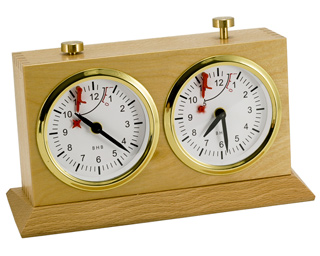
Any tournament player will tell you that a good chess clock is just as important as the board and pieces. What constitutes a good chess clock can often be the subject of heated debate. This is because there a variety of designs and types of chess clocks to choose from and everybody has their personal preference.Types of Chess Clocks

All chess clock have a few things in common. They have two clocks positioned side by side, one for the white pieces and one for the black pieces. There are two buttons or a lever. Depressing the button on your clock will stop yours and start your opponents.

The first choice to make is whether you prefer an analog or digital clock. Many purists prefer the analog clock. Each clock is set just as an analog wall clock would be by twisting a knob on the back until the hands line up correctly. There is a flag hanging from the 12. When the time has expired the flag will fall and players are responsible for noticing when this happens. Some analog clocks run on batteries while others require winding. Most are shaped in a rectangle with the buttons on top. Each button above its respective clock. Today the casing is usually made from a polymer or plastic but older ones are typically made of wood and are much more durable. In most cases, an analog chess clock will be less expensive than a digital one.

Digital clocks are very popular for a number of reasons. The LED displays the time remaining to the second. Many players feel they need to know exactly how much time they and their opponent have remaining. Many of the digital clocks have a much lower profile so players do not have to lift their hands very high to depress the button or lever. Some digital clocks are able to connect to specially designed boards that can sense when a piece has been moved and automatically stop and start the clocks. When one of the players runs out of time, an alarm sounds letting them know the game is over.

Chess Clocks In Play

Tournaments are the most obvious reason people use chess clocks. Each player has the same amount of time to complete either a set number of moves or for the entire game. If one player runs out of time, they lose the game. It is a good way to ensure the players have a fair game.

Many casual players prefer using a chess clocks as well. Lightening and blitz games are popular and rely on heavily on chess clocks. In lightening games the players will have between 1 and 3 minutes each to complete the game. Blitz uses time controls between 3 to 10 minutes per side.

Chess clocks are also used to handicap games. If one player is much stronger than their opponent, they may only have 5 minutes to complete the game while their opponent has 15 or 20 minutes.

Chess Clocks As Training Tools

Many instructors use chess clocks to help ensure pupils have memorized various opening lines. By putting strict time controls on the opening sequence of moves, they can easily determine how efficiently a student has mastered an opening. The same methods are also employed in end games to evaluate how well the student understands various principles.

Chess clocks have been around for years and are as important a part of the game as the pieces themselves. If you haven’t played chess on the clock, you are missing out on one of the most exhilarating aspects of the game. The Regency Chess Company® in the UK is one of the largest stockists of chess clocks with some excellent prices too.

Who Plays Chess, and Why?

?

Chess is played by a diverse range of people for many different reasons, they enjoy the companionship it offers, the skill and logical thinking it involves, the fact it can be played anywhere, and it’s a lot of fun and extremely challenging.

The main advantage of chess is that it allows you to make new friends and meet interesting people, whatever your age or wherever you live you are never alone if you can play. Popular with retirees as they have a lot of free time, it gives them a chance to exercise their brains and maintain mental alertness but doesn’t require too much physically.

Like many other games it’s a great way to wind down after a hard day at work and to relieve stress, having to concentrate and think about strategies takes away all thoughts of what happened that day and has a particularly soothing and calming effect. Said to improve thinking skills it can help you to reach a decision that might have felt unsolveable previously, and get your thoughts under control.

There are chess clubs all over the country that attract people from all walks of life, and just go online and you’ll find forums for the game where like-minded people have the chance to get together and talk about strategy and technique as much as they like. Carry chess sets with you when travelling and guaranteed you won’t be alone a lot – people will see the board and either strike up a conversation or challenge you to a game and soon you’ll have company and may even make a new friend or two!

Chess buffs are more than happy when they meet a fellow enthusiast as they can talk about their favourite subject for hours on end, and then some more! They love the structure of the game, the rules, and ruminating over strategies of famous games, they will invariably know every well-known player there is, what games they played, their opponents and the sequence of moves in famous games. An enthusiast is lively and logical, interested in lots of things, and they love a challenge particularly if it involves using the brain.

Professional players form chess clubs start off competing in local and then national competitions and tournaments, if they’re good enough they’ll end up travelling the world to participate in international matches. The best players have the capability to visualize the board in anticipation of moving the pieces, some are lucky enough to have a photographic memory which makes it easy for them to calculate the next move. Many hope to one day become grandmasters and they dedicate a lot of spare time to learning the inspired moves of past grandmasters and developing their own distinctive approach to the game. Try a folding chess board for easy transportation and take it with you wherever you go.

With online games becoming so popular it’s becoming increasingly popular with the younger generation, in some schools chess is now included on the timetable due to its known positive advantages including improving the reasoning process, ability to assess situations, increased self-motivation and self-confidence. Chess clubs are also common in universities particularly with mathematics students, it makes people feel part of a team and so encourages friendships, and as it’s known to develop both social skills and self-confidence it’s a game you should be encouraging your kids to learn.

When buying chess sets make sure it’s practical and sturdy, particularly if you are planning on carrying it from place to place regularly.  Take a look online as there’s a broad range of chess boards and pieces available, compare prices and quality by checking a few websites before making any decision. Sets are made from all kinds of materials such as rubber, plastic, glass and even stone, wood sets are generally the most popular as many are designed to be folded in half so you can safely store the pieces inside which is convenient for travelling, some also have an added handle letting you carry it around like a briefcase. Wood lasts for a long time and grows more beautiful with age. Choose from pine, walnut or oak, or pay a little bit more and get a set in ebony or rosewood.

Teach Chess to your Kids

Chess is a game that is enjoyed by people from all walks of life and from young children to the elderly. You don’t need an expensive board to play chess and the one you do eventually buy is likely to last you for ever. Many fanatics of the game play on boards that they have had for years and love the feel of the pieces as they move them around the board nearly as much as the game itself.

Buying a chess set makes a great gift for anyone and can open up a whole new area of interest by allowing you to acquire new skills and make new friends with the same interest. There are clubs, internet sights and chat rooms where you can discuss games and moves until the sun comes up if that’s what you wish to do.

Buying a chess set that will be located at home means you can choose whatever size you like and made from whatever kind of material you prefer as it will be staying in one place. Although wooden chess sets are generally the most popular there are also lots of lovely products made from marble and glass to look out for if you want something more ornate. They look great displayed on a table or sideboard with all the pieces set up enticing those who see it to play a game.

Teaching your kids to play chess can train them to use a lot of skills that will come in handy throughout their life; it teaches them to focus, increases developmental thinking skills, and helps with logical thinking, decision-making, mathematics, problem solving and critical thinking. It is great practice for improving alertness and concentration and helps with memory retention – kids that play chess are liable to do well in their exams.

Take a visit to a chess store and you’ll be amazed at the sheer amount of choice on sale, particularly for kids which can be a lot of fun as there are many designs produced in creative and imaginative themes. You can find hand painted or plain wood styles designed with kids in mind as they are made specifically for those with a smaller arm span, plastic and wooden sets can be more durable and longer-lasting. Toy stores also have a selection of sets to check out that are fun and economical and are a great way to introduce chess to youngsters.

Choose a theme that appeals to your child, for boys’ dragons and dinosaurs are always popular, check out dragon knights riding motorbikes, dragon castles carrying surf boards or dinosaur pawns in all kinds of humorous poses. The characters of Peter Rabbit are super cute and sure to inspire younger kids to learn how to play. Or for older kids Robin Hood and his merry men battling the sheriff of Nottingham to save maid Marion across the chess board is a great historical and fun way to play.

If you’re shopping for a daughter then check out Alice in Wonderland, a timeless classic that comes complete with the chess pieces as the characters of the story. You can get it in either colourful painted figures or carved in plain wood design.  Or Winnie the Pooh chess pieces, a classic character that will be treasured by every child even when they’re grown up.

Buying a luxury set for your children can mean a gift for life that they can then hand down to their own kids when the time comes. Invest in a quality product and it will stay in the family for years to come, educating generations of kids and providing endless hours of amusement.

Order your set online and get it delivered for free within the UK. With express shipping available on the mainland you won’t have to wait around for your gift to arrive – it will be there the very next day and the fun can begin.

Chess Clocks, why should I use one?

Why use a chess clock? Surely they are only for the totally serious chess fanatic and not useful for my games of chess? However it’s likely that even the beginners among us in the chess world would benefit from having a clock present during our chess games. When the clocks ticking time between moves is measured and limited. Instead of those Sunday afternoon epic games that never seem to end before dinner you get competition style chess where a winner is certain, even if it isn’t you!

If you head into most town centers looking for buy a chess clock you will hopefully have some good walking boots and plentiful provisions. Essentially they have become specialist items and the only place to buy them now is chess specialists, which usually limits your shopping experience to the Internet. There are some key brands in the chess clock market, mostly European companies who have an interest in chess strategy and advanced tournament play.

DGT have emerged as the leaders in the digital chess clock arena whereas the German company Garde still represent some of the best analogue clocks (as well as digital) available. Of course there are plenty of generic clocks on the market, many will be hastily branded accordingly for the retailer selling them. Then there are the many Chinese cheap  chess clocks that are great for bulk school purchases, just don’t expect them to last as long as their European counterparts.

A good quality chess clock shouldn’t be expensive, expect to be able to buy something good for well under £80, remember that these things are not produced in mass quantities like cheap sunglasses and razor blades, so don’t expect anything too cheap!

Hip-Hop & Chess, an unlikely partnership in the fight on crime

chess player

A new movement is taking the chess world by storm in the USA. The Hip Hop Chess Federation is using chess to promote unity, strategy and non violence among young people in America. The Federation combines chess with music and martial arts to encourage young people to develop skills and attributes that will help them to avoid crime.

The process of playing chess develops peoples sense of strategy, decision making and realizing the consequences of their actions. It develops patience and skill and is a universal game that can be played accross cultures, language barriers and different social groups. Irrespective of ones race, gender or background, playing chess can unite people and develop an understanding of other peoples needs.

The Hip Hop Chess Federation was Founded by award wining lecturer and author Adisa Banjoko and Leo “Blast” Libiran.

“Despite the school system’s best efforts and intentions, and the efforts of overworked parents, the past generations have suffered from lack of suitable education and essential resources required for a successful life,” states co-founder Adisa Banjoko

It is hoped that the young people of America will benefit socially from the good work done by the federation. By creating a culture where a chess set takes the place of drugs or weapons on the streets of America a more prosperous future will lie ahead. The federation has received huge support from various well known artists. By aligning itself with iconic institutions of youth culture it makes itself accessible to young people who may have previously associated chess with the privileged & wealthy.

Scroll to Top