Chess Players

A Faux War is no War

I’d like to discuss the popular use of warfare comparisons to games, chess in particular. Fischer was a fan of such analogies and I suspect that this is the source of such phrases’ popularity in the chess world. Just know that your carelessness makes you sound as ridiculous as this. I can’t agree with you here Big Ticket! When I play chess I don’t go into combat with children, the elderly, and the infirm. If you feel that your next chess antagonist is your enemy, I’d say the potential for checkmate is not your biggest problem.

When you atomize the chess-warfare comparison, using it without regard for its consequences, you get something mind-numbing. If chess is war, then it’s acceptable when 7/8 of your army dies. As long as you win, your Pyrrhic victories still net you a rating bump. I get called out by my chess coach when I do not sacrifice enough material. The easiness of such an analogy means we must be ever on our guard.

Comparing a pastime to war breaks down the distinction of the latter as something primal and ugly. War must remain a thing apart from everything else. It’s not to say that it should completely leave our consciousness, but it cannot be fun while remaining an option of last resort. The victims of our little language breakdown include a sitting U.S president himself.

Lost in a boyhood fantasy, one erstwhile GOP leader decided to tip over a “king.” It’s instructive to look at his language, as well as that of the military high command, from 2003-2008. You’ll find plenty of language that sounds suspiciously like the type chess players use without thinking. Don’t “tactical shot”, “psy-ops”, and “smoke ’em out” speak of something dark and deep? Let’s not encourage their use without true context.

I haven’t charged any machine gun nests, stormed houses, or held a bridge by my lonesome; I only served with people who did. Most, not all, came back thanks to advances in battlefield medicine and technology. But none returned quite as they left.

Veterans hate war analogies because we never want you to experience life as we have. The human animus is often dark and people die because of that darkness. The point of our going overseas is so we can make your comparisons baseless. Let us do that so you can play your games.

Back to veteran’s hospitals, they have them (under different names) in all developed countries. You ought to stop by sometime to see what truly happens to your nation’s soldiers when they get put back in the box.

 

Ghosts: Inside the Bestiary, Part One

Some ghosts serve their creators as carriers of transcendental truth, as visible or audible signs of Spirit. Other ghosts carry the burden of tradition and collective memory…ancestral apparitions often act as correctives to the insularities of individuality, as links to lost families and communities, or as reminders of communal crimes, crises, cruelties…. – Lois Parkinson Zamora Magical Romance/Magical Realism: Ghosts in U.S and Latin American Fiction

All tournament-goers believe in ghosts; threats that hold no true power. There’s a moment in every game where the limen between the real and unreal fades to nothing. Amateurs make minor concessions when not required, and surrender initiative without reason. True to the quote above, what we see in front of us is our own history- warped by past mistakes. Let’s get cozy with our cast of ghosts, in ascending order of malevolence. Later we’ll talk about how we can bust these phantasms like they deserve.

Casper the Friendly Ghost: It is a harmless one-mover without an ulterior motive. It drifts from move to move “booing” for no good reason. If your opponent is Casper, you can often use the inclination to chase you to your advantage. Keep your position fluid and open. Casper hopes that by making you move you’ll eventually slip up and give him a tactic with which to win. This is its only power.

The Headless Horseman: This one is a bit more dangerous. Its cognition is not fully there , being, sans head, but HH certainly is aggressive. Don’t worry about subterfuge; creation of a hole or another strategic weakness is not the goal. Material is the focus. The Headless Horseman baldly tries to pick on your overworked pieces, pieces that share one another’s squares, or lack of space. HH sees weaknesses even though it finds them difficult to exploit; it is terrible at creating multiple threats to undermine your defense. HH will pile everything but the kitchen sink onto an isolated pawn when he would be better off using the opponent’s immobility to attack another area. Naturally the more you respond to this knight errant the more powerful he becomes.

Ghost Dad: Bill Cosby played a father with a heart of gold, killed by a taxi-driving maniac. He has only a few days to become a better person and straighten out his priorities. His motivations are sincere and he has a definite plan to get a favorable result. Ghost dad threatens to use your vulnerabilities to aid his development, plunges his h-pawn forward, and plays a4 after you play a6. Not only does he make threats but he anticipates your responses. He is willing to consider positional aspects to achieve his goals.

Frederick Krueger – More intimidating than the previous because like a true ghost he gets into your head. In fact if you don’t wake up soon from the dreams he inspires you’ll certainly be lost. Kreuger inspires phatasmagoria and an inability to know which parts of the onslaught are real and which are fake. Robert Englund’s serial killer can stay with you between games and scare you whenever you see his likeness.

Just off the Beaten Path

This is Gurgenidze versus Spassky, 1959. The opening is the Bird Defense to the Ruy Lopez. I like how Spassky acquits himself here. I’ve made some annotations, since I’m an aficianado of the opening. Spassky is one of my favorite players because it’s rare to see someone so skilled play sidelines not highly regarded by theory.

1. e4 e5 2. Nf3 Nc6 3. Bb5 Nd4 4. Nxd4 exd4 5. O-O c6 6. Be2 {The bishop can
go just about anywhere. I didn’t see this line in the MCO but white still
enjoys an advantage here.} (6. Bc4 h5?! {There is a creative Indonesian master
who plays this move reguarly. I adopted it immediately after looking at his
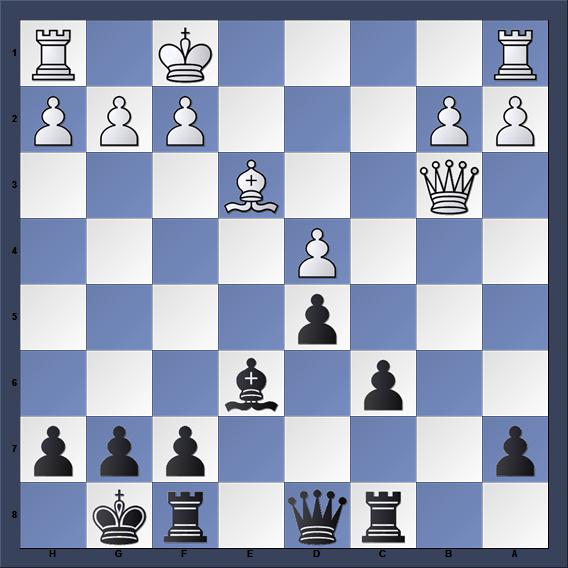
games. It leads to interesting play. It’s hard for white to get his queen and bishop into
the game. See the picture below.} 7. d3 Bc5 8. Nd2 d5 9. exd5 cxd5 10. Bb5+ Kf8 {Not Bd7 where white just has a superior endgame. This is a position that I reach a lot and like
very much. I like black’s space and the weakness of white’s light square
bishop. An attack on either wing is possible.})

6… Bc5 {The bishop isn’t so bad here. White usually plays c3 later.} 7. d3 Ne7 8. Nd2 d5 9. e5 {I don’t like this move. By occupying e5, a weak square, with a pawn white loses the
ability to put a piece there. The position is equal now.} Be6 10. Nb3 Bb6 11.
a4 a5 12. Bg4 O-O 13. Bg5 {The knight is misplaced on the queen wing.} Qd7 14.
Bxe6 fxe6 15. Bxe7 Qxe7 16. Qg4 Rae8 17. Nd2 Rf5 18. f4 Ref8 19. g3 Qb4 {Even
though the position is closed the knight isn’t necessarily superior to the
bishop. To get the knight in the game white will have to try a pawn break with
c4, or try to use the h3 square.} 20. Nf3 Bd8 21. b3 Qc3 22. Rac1 b5 23. Rf2
Qb4 24. Rcf1 bxa4 25. bxa4 c5 26. Nh4 Bxh4 27. Qxh4 Qxa4 28. g4 R5f7 29. f5 Qe8
30. f6 Rb7 31. g5 a4 32. Kh1 Ra7 33. g6 Qxg6 34. fxg7 (34. f7+ {!?} Raxf7 35.
Rxf7 Qxf7 36. Rxf7 Kxf7 37. Qe1 Ra8 38. Qb1 Kg6 {I like black here, but the
engine says that he’s lost. It’s hard for me to see how white can prove a win
here. Everything’s defended for black. I’m sure white must have seen this
continuation and rejected it.}) 34… Rxf2 35. Qd8+ Kxg7 36. Rxf2 Rf7 37. Rxf7+
Qxf7 38. Qg5+ {Perpetual check} *

Whether you like my pet line or not, I think we can both agree that the Bird Defense, with its doubled central pawns for black (nearly always), offers imbalances right away. Those of you who follow Silman’s approach to the game may appreciate the clearly drawn lines that the opening creates. Give it a try and let me know how it goes. It’s an interesting theme.

Anand vs. the World

Vishy Anand won the 2012 Chess World Championship and already ranks among the strongest players of all time. The chess community knows him as a fantastically consistent competitor. This is due in part to his excellent preparation, evidenced by the stellar match record he holds. Recently he agreed to a game on Chess.com billed as “Anand vs. the World.” It was so-called vote chess wherein the power of a crowd is harnessed against a true star of the sport.

Unfortunately I looked at the game only afterwards; I think watching games live is a very instructive way to think about developing one’s game, and I’m quite sorry I didn’t get to be on the world’s team. You don’t really take in a sport just from a box score or a sheet of notation.

The drawn game provided a favorable result for the unwashed multitudes, since you don’t simply arrive at a group’s rating total by adding up their points – you also bring into the fold each member’s bad form. Sometimes a group is less than the sum of its parts; the American Legislature for instance has 535 participants, and together its members produce little more than spleen-filled bluster .So here is how the group acquitted themselves.

1. d4 d5 2. Nf3 Nf6 3. c4 c6 4. Nc3 e6 5. e3 Bb4 6. Bd3 O-O 7. O-O Nbd7 8. a3 {
Think back to Bb4. White’s pawns will now be doubled. While it seems easy to
trade off one of them for the d-pawn the recapture with the e-pawn allows a
Carlsbad Structure without white’s normal piece activity. His knight is also
on f3 rather than e2. While the bishop remains in position it indirectly
relieves pressure on the d-pawn.} Bxc3 9. bxc3 Qc7 10. a4 {I don’t truly
understand this move. Black’s b5 push is pretty standard. Perhaps Anand just
did not want to play those complicated Meran Lines without a prize on the line.
The last thing you want to do is give away a novelty in a game of skittles
chess.} e5 {Black can get in his important break.} 11. Nd2 e4 {Black’s bishop
problem is solved and he is not worse.} 12. Be2 {Without looking ahead ask
yourself if you would capture on d5 with a pawn or a piece. They’re both
reasonable tries, with objective evaluations closely resembling one another.
They lead to different play however.} Re8 13. Ba3 Nb6 14. c5 Nbd7 15. c4 Nf8
16. Rb1 Ng6 {Black has plenty of space. At least four pieces will vie for
white’s king. It’s not so easy to come to the defense. White’s avenues are
quite closed on the queen wing.} 17. Qb3 Rb8 18. Rfc1 Bg4 19. Bf1 Be6 20. Be2
Bg4 21. Bf1 Be6 22. Be2 Bg4 {There were other moves for both sides. Qd1 for
white and Ng4 for black would have kept the game level.} 1/2-1/2


Remembering the Wine-Dark Sea

It snowed from the north/
rime bound the fields/
hail fell on earth/
the coldest of seeds – Anonymous, 9th century

But nowadays when we read this there is an added poetry. There is the poetry of a nameless Saxon having written those lines by the North Sea—in Northumberland, I think; and of those lines coming to us so straightforward, so plain, and so pathetic through the centuries. – Jorge Luis Borges, This Craft of Verse.

After reading this, I considered how the rolling on of years impacts our creations. We all know that refined masterpieces can be stricken with bathos in their twilight. What about those chess games whose luster suddenly seizes hold, years after the fact? As we grow, and not to say shrink as older minds do in pivotal ways, we experience different forms of understanding; the world looks very different when we’re moving away from it. Very old games feature a world of color, but you need the right instrumentation to see them, a spectroscope. Shut your Shredder, hide your Houdini, and remove your Rybka. Schlecter and Marshall, Paris, 1900.

1. d4 d5 2. c4 e5 3. dxe5 d4 4. Nf3 Nc6 {Here we have the Albin Countergambit
tabiya. Modern theory favors Nbd2 but g3 has always been another favorite. If
black isn’t careful the g2 bishop can become simply absurd.} 5. g3 {I’m
surprised Marshall didn’t play 5…f6 here. It’s a true gambit and suits his
style. White’s queenside pawn strike strikes with force though.} Bc5 {I like
this move. Marshall chooses simple development. He will work on the e-pawn
while developing naturally.} 6. a3 a5 {Cannot allow b4 from white} 7. Bg2 Nge7
8. Nbd2 Bg4 {Indirectly pins the d2 knight. White’s pawn on e5 can’t be held
unless the knights continually support one another.} 9. O-O O-O 10. h3 Bxf3 11.
Nxf3 Ng6 {The position is rather balanced. It’s difficult for black to know
whether to open the game or not. He’s being pulled in two different directions.
This opening is for the resolute!} 12. e6 {The pawn was dead. White gets
something for it.} fxe6 13. Ng5 Re8 14. Qb3 Ra6 15. Qb5 a4 16. Bd2 d3 {Black
has been planning to use the lever since the opening.} 17. Qxc5 dxe2 18. Bc3
exf1=Q+ 19. Rxf1 Nce5 20. f4 Nd7 21. Qe3 Nf6 22. Qf3 {Every great chess game
passes through the = point.} Rd6 23. f5 exf5 24. Qxf5 c6 25. Ne4 Rde6 {The
pawn isn’t really free. Can you see the thematic idea for black?} 26. Bxf6 gxf6
27. Nxf6+ Rxf6 28. Qxf6 Qxf6 29. Rxf6 Re2 30. Rf2 Re3 31. Rf3 Re1+ 32. Rf1 Re2
33. Rf2 Re3 34. Rf3 Re1+ 35. Rf1 Re2 36. Rf2 1/2-1/2


The Autumn of the Patriarch

Over the weekend the vultures got into the palace by pecking through the screens on the balcony windows and the flapping of their wings stirred up the stagnant time inside, and at dawn on Monday the city awoke out of its lethargy of centuries with the warm, soft breeze of a great man dead and rotting grandeur –  Gabriel Garcia Marquez

Autumn of the Patriarch focuses on a leader’s last days; his life, once a blend of grand gestures and sensuality, comes to nothing but disorder. A cow holds court from the presidential balcony. The battlefield squalor inside the palace seems to embody the spontaneity of a coup, but even the dead dictator knows that gross misjudgments foreshadowed his difficulty. So regarding this incarnation of your king, what will be the true anatomy of his disaster as you will tell it later? Here’s mine. I’m playing against Justin Armstrong, 1670 USCF, in a Game 60. I am white and the text is below.

The Autumn of my Patriarch


1. e4 e6 2. c4 {An intriguing system that often leaves white no worse than ina normal French. Some choose not to play d5 at all and white keeps good chances. I also play the Maroczy Bind against the Sicilian. I like to play similar pawn structures.} c6 3. d4 d5 {E5 is good here. White gets a slightly better French Advance. The c5 break will take two moves for black. Black may have to take on the isolani as well.} 4. cxd5 exd5 5. exd5 Nf6 6. Nf3 Be7 7. Nc3 Nxd5 8. Bc4 {The wrong place for the bishop. Bd3 is thematic in such structures because e4 and c4 lack pawn cover. I’m hoping that black changes the pawn structure and would like to induce him to do so.} Bg4 9. Nxd5 (9. Qb3Bxf3 10. gxf3 O-O 11. Qxb7 {I failed to asses this as good for white. I am usually too paranoid to scoop up a b-pawn.}) 9… cxd5 10. Qa4+ Nc6 11. Bb5 Bd7 12. Ne5 Bb4+ 13. Kf1 Nxe5 14. Qxb4 Nc6 15. Qe1+ {It’s better to stay put. White will soon lag in development.} Be6 16. Qc3 {Yet another queen move. The lady is fickle.} O-O 17. Bxc6 Rc8 18. Qb3 bxc6 19. Be3 {The rest is immaterial. Bad governance has rotted the position from within. Multiple queen sorties and the arrogant king move leaves white struggling. Do not cause yourself problems you have no inkling of how to fix!}

There is some good news though. Like the composite rulers in the novel, the king seems to embody eternity, so does he rise from the box without wound or memory.

The Will to Win

I saw a black cat eating grass the other day during a drive through Philadelphia. I looked into its lantern eyes and there wasn’t a trace of contempt; it was thankfully rooting shoots up from the ground even as our stoplight turned from red to green. I hope that on those days that I’m spiritually reduced to such bare-earth clawing, that I can muster such equanimity.

Humans in dire straits often become aloof, and cling to old notions of how things should be; we design a future world based on the glory of our own antiquity. Sometimes we should instead rework our own ideas to achieve something practical. I’ve volunteered in homeless shelters where I’ve found patrons refusing to eat the food given them. Someday there will be an end of the world, both of our own private life and society’s at large, but until then no situation is so terrible; play out your private drama. It is the only thing that’s yours alone.

Since I know you’re above such sincere gestures as gnawing at festuca, maybe we can start with something smaller. When you find most of your pieces consigned to an opponent, don’t concede. Muster what you have in the best way you know how. If you feel hopelessness, ignore it; if you feel angry, banish it; if you feel ashamed of being ground down, enjoy the perfect freedom of facing an insuperable difficulty.

Everyone loses, but in a chess match you get to do so slowly, with plenty of time to sit and understand. Many of our difficulties in life, by contrast, engulf us completely and in the swirl of one moment. These tough times offer little to make us immediately mindful. I like to sit being a queen down and learn a little bit more about who I am. I like the knowing, sad-eyed spectators. I’ll see them in the lobby, in about three hours, with a wonderful story!

I’d like to present a beautiful game that reinforces my idea.

Evans – Reshevsky (1963) “The Swindle of the Century”

1. d4 Nf6 2. c4 e6 3. Nc3 Bb4 4. e3 c5 5. Bd3 O-O 6. Nf3 d5 7. O-O dxc4 8. Bxc4
Nbd7 9. Qe2 a6 10. a3 cxd4 11. axb4 dxc3 12. bxc3 Qc7 13. e4 e5 14. Bb2 Nb6 15.
Bb3 Bg4 16. Ra5 Rac8 17. c4 Nbd7 18. h3 Bxf3 19. Qxf3 Rfe8 20. Rd1 Ra8 21. c5
Rad8 22. Ba4 Re7 23. Rd6 b5 24. Bc2 Nxc5 25. Rxd8+ Qxd8 26. Qe3 Ncd7 27. Qd3
Qb6 28. Bc1 h6 29. Be3 Qb7 30. f3 Nb8 31. Ra2 Rd7 32. Qa3 Kh7 33. Kh2 Qc7 34.
Bd3 Nh5 35. Rc2 Qd8 36. Bf1 Rd1 37. Rc1 Rd6 38. Qa2 Qf6 39. Rc7 Nd7 40. Ra7 Nf4
41. Qc2 h5 42. Qc8 Rd1 43. Bxb5 Qg5 44. g3 axb5 45. Rxd7 Re1 46. Rxf7 Rxe3 47.
h4 Re2+ 48. Kh1 Qxg3 49. Qg8+ Kxg8 50. Rxg7+ *


The Human Stain

I just finished reading The Human Stain by Philip Roth. Two years before the millennium, sex scandals rocked President Clinton’s White House as, closer to home, Coleman Silk’s academic career suffered from the withering attack of morality pundits. Now, if you remmeber life in 1998 New England you weren’t really there; it was then like it is (nearly) always, puritanical to a fault.

Prudes and hedonists launched very public broadsides against one another. Public classrooms, like my 11th grade English group, erupted into spontaneous shouting about morality, immorality, and indifference. This was unlike anything in my direct experience. People didn’t talk about sex candidly in New England. Cotton Mather still kept a house down by Cape Cod for Pete’s sake; yet, the colorful presidential drama had students excited about their world in a way that no other personal drama could.

I didn’t think about chess in the turgid excitement of my youth, knew how the pieces moved but not much else, but looking back I wonder if the sex scandals, as we experienced them, in a frame of mind both provincial and immature, can teach us something about the game we enjoy today.

With human longing, dropping all pretense for a moment, being a prime motivator, how does chess play, and perhaps chess study, fit into our lives? As I’ve mentioned before, a pair of us are preparing for a large tournament being held some distance away. It will not be cheap and it will not be easy. It’s instructive to think on what takes a person, in this case a pair of working adults, to travel far away to do something which they’ll later recall as stressful and excruciating. It is the everyman’s solo Amazon trek, the fat man’s swim of the English Channel. It’s like those things but you’re sitting for long periods. Afterwards your brow won’t stop furrowing and you sleep for days. True story. So why?

1) A competitive nature? I don’t have it and I don’t want it. The best day of your life is the day your fire mellows out a bit. I watch the warm glow and I see safety in its gentle licking.

2) Money? The prize is nice, but I do alright. You don’t go to a tournament like this unless you can afford to lose; failure to place is the probable result of a given chess outing. I’m comfortable and happy with being down the entry free and gas.

3) Something to prove? Am I revisiting a moment in the past – it is clear as a sunny day to me, as I can still explore its stinging particulars in my mind – in which I failed to accomplish what I desired? A young man in a moment too large, I can answer to the affirmative. This is in me.

4) Just to do it. It’s not 1998 anymore. I get laughed at when I pull out my license to try and buy liquor; put that thing away you old geyser comes back the grin of an acne-packed cashier. I think my youth went to the same place that old Throwing Copper disc did when it finally expired. Then I had nothing, no one, and was a flat broke fifteen year old. He doesn’t have much in common with the man I am today; I’m comfortable in my professional life, carefully choose those with whom I interact, and have double the years.

Still, I see both people as stained somehow. I’m not talking about an atavistic thing that impels us to stupidity, but about the ineluctable drive to reach the summit of your powers, though that potential may be dynamic, and not to say trending upward. So I’m psyching myself up for this tourney, pretending to stir up some real care for something I know has no consequence, and I want you to do the same facing whatever peak you face next. It’s a magician’s ruse; keep pulling stuff out of the hat even when you think its empty.


The 2012 World Open

I’m taking a little vacation to the City of Brotherly Love. On July 4th, with any luck, I’ll be celebrating my independence from the worst run of chess I’ve ever played. In the spirit of a wonderful holiday, I declare these truths to be self-evident:

1) I need to set aside time to look over tactical puzzles. One hundred per day at Chesstempo.com should be sufficient. I will step up my physical exercise routine as well. Mens sana in corpore sano.

2) I must learn my openings a little deeper. I will refresh my repertoire, plugging holes as needed. I will play top-level openings, leaving pet lines for skittles and blitz.

3) I must study the masters to think like them. Once a week I will dedicate two hours to studying the greats, particularly the middle games in which I will find myself.

4) I will not settle for merely a good move. I will make the best move that I can. The first move that I generate is right only about thirty percent of the time. I don’t like those odds.

5) I will assume that my move is incorrect, and play the devil’s advocate.

6) I will play for initiative when it is appropriate. I will look for an attack when the position calls for it. I will not simply castle or develop a piece when there’s a real possibility of a winning tactic.

7) I will not balk at complications, but welcome the opportunity to gain an advantage in a dynamic position.

8 )  If my opponent has two bishops, and I choose to open the game, I will be darned sure that my initiative is an enduring one.

9) I am playing in a lower section but I will not give anyone the gift of my overconfidence. I play against pieces not people.

10) I will have fun and not play for results. There is no way to determine the future except to prepare successfully. When opportunity knocks be ready with your hat and coat.

The Chess Ecosystem: Children of the Corn

They get their designation from the American horror of the same name. The plot involves crazy children doing a lot of unkind things to adults. If you’ve ever lot to anyone less than 4’6″ then you understand this label. Note: A subset of the species is the “child that will Soon be better than you”; the difference is that the brilliance of the latter is not yet fully developed, offering a scant glimmer to the middle-aged chess enthusiast. It won’t last long.

Identification: The children of the corn are usually demure, and not quite socially comfortable. They come between ages twelve and sixteen. They may have a signed board and/or a father who is a chess master. They are extremely precocious, usually second-generation Americans, and often attend school at home. Research agrees that they take instruction from the “Overly Critical NM Father”. Chess-wise they are highly tactical and booked-up. They are a curious juxtaposition of mathematical smarts and gross childhood habits, like nosepicking.

Sometimes you can see the Children of the Corn running through the halls in a gaggle of small people. They make a lot of noise about their winning positions, regardless of the results, and are easy to spot at any tournament across the country. They hate adults, and secretly relish beating them. They’re bitter inside because of their regimented lives and take it out on the insurance salesman or middle manager sitting in front of them. Scary.

How to beat them: You can’t. It’s lose/lose. What are you going to do, brag to your buddies about making a youngster burst into tears? If you lose, you darned well know you can’t tell anyone that. A friend lost to a ten year old not long ago, in about fifteen moves. The little conqueror used his extra time wisely, running through the tournament like an airplane, ADHD in full bloom. The best you can hope for is that one of them will become really, really good and, if you cracked them once, you get a story out of the deal. If they have a weakness it’s their underdeveloped psychology. You can wheedle them into a draw even when it’s not beneficial for them to accept.

Fortunately losing to a Child of the Corn is not all bad. They’re plenty eager to regale you with the fruits of their chess study. They’re extremely booked up and if they play an opening move it’s probably from Fritz. Save yourself some time and just play what they play. A postmortem with the rug rat will teach you a lot.


Scroll to Top