Chess Puzzles

A Great Puzzle

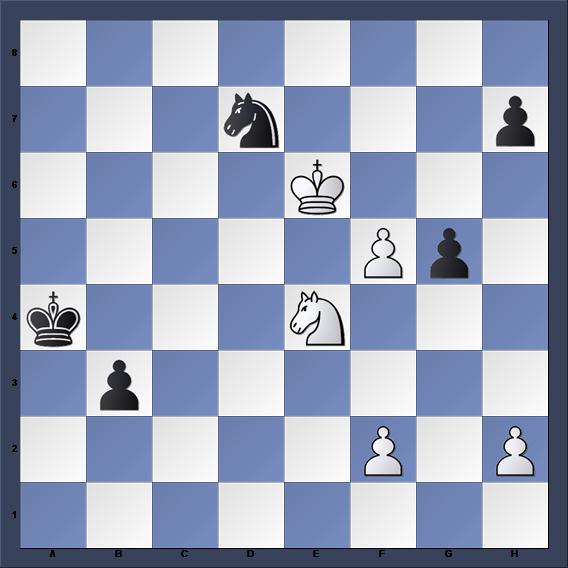
It’s black to move. Is this a win, loss, or draw?

This endgame comes to us from a Ruy Lopez. If I were to teach a student only one position from any game I’ve ever played, this would be the one. There it was in front of me and I knew that it was special.

I solved the puzzle without knowing how I derived the answer. The process started me thinking about how I approach chess positions. Naturally you must catalog your mental errors before you can stop making them, This is “My System” of thinking, warts and all. Be mindful that no system is universally applicable and that the thinking process is not necessarily linear. Finding whether a move is forced or not (Step One) may require positional consideration. Dart back and forth between stages and add your own.

1. Forcing Moves? If I must make a particular move then I ought to start my analysis only afterwards. Black must move the knight. Three moves result in capture. Both moves to the second file allow white’s passer permanent king protection. So we’d like a check, but after  1…Ke7 the knight is doomed. What to do!? I’m stuck between actively degrading my position and losing a piece. I can’t fathom moving anything but the knight either.

2. Where does my piece belong? We must take into account the piece’s ideal placement as well as the feasibility of the maneuver. Here the black knight can use its peculiar geometry to either harass white’s king and pawn or assist in the black’s pawn’s promotion. The second choice can be eliminated due to time constraints. Once the knight leaves the premises, white will queen. A piece can belong nowhere too, and this is the case here. Black’s knight cannot stop white’s queening attempt because of the b-pawn. Were that pawn not there, white could insist upon the sacrifice indefinitely. The knight can buy time by sitting on the queening square however. Part of your material inventory involves seeing when a piece is no longer materially valuable. Maybe it can proffer some other resource. I love Pal Benko’s endgame manual, but if the winter gets cold enough it’s of greater worth inside my fireplace. The king is also firmly moored to its side as well. Relative immobility of the pieces means tactics will predominate.

3. What does my opponent want to do? What are the consequences of his plans? Are they local (affecting one part of the board) or global (affecting the whole board)? Seizure of a square usually affects a region but promoting a pawn affects everything for instance.

4. I break the board down into sections. There are often, as here, two, or even three, separate chess games within a position. Even with long-range pieces the balance of power in a sector changes slowly. Can the pieces in one sector stymie my opponent’s plan? Are my pieces able to achieve the strategic aim in a given sector? If I lose the “battle” on the queen wing do I have adequate resources on the king wing? Clearly I do not. If I cannot stop my opponent’s plans I must ruthlessly pursue my own.

4. I decide what a winning situation looks like in my area of activity. How do I know I’ve been successful? What must happen? What cannot happen? My success might involve marooning white’s knight on b1. Black’s king can give chase and the beleaguered knight can neither give itself up or stray too far. A draw by repetition will follow. Another try is using the king to bar the knight’s entry into key squares. Is this possible? I fail if I cannot oust the knight in time. How can I lose time? If the white knight and black pawn make me lose tempo.

5. I decide on the move sequence. Which path should the king take? Referencing step number four we can see that Ka3 unnecessarily blocks black’s king. B2 and Kb4 are interchangeable because white will take the knight. Thus one route lacks independent value and I need not analyze it.

I hope you’ve enjoyed this brain-inspired bric-a-brac and that it improves your chess!


The Gentle Art of Persuasion

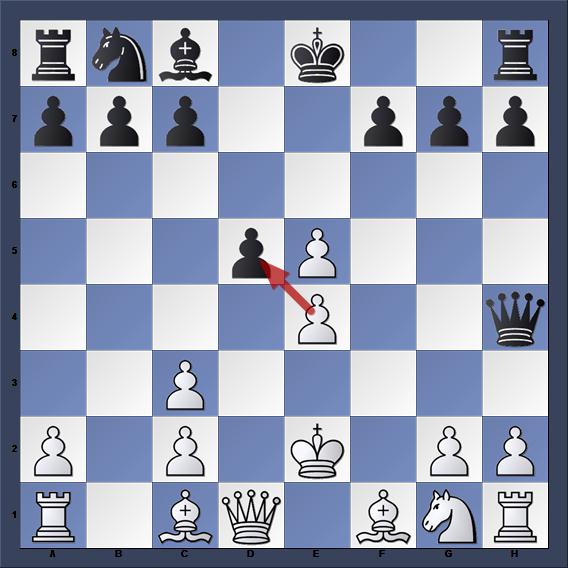
The last time I wrote, the material concerned Gurgenidze-Spassky from the fifties. I’d like to follow up that effort by showing you a game of my own, and one that I think is already being spoken of in hushed tones wherever chess is played. I have the white pieces, but not for long due to the battle’s quick culmination. My analysis is that my opponent’s nerves did not have the rigor to withstand my plucky strategic conceit in the opening. Daunted by the prospect of continuing play against an actual chess author my opponent, ostensibly looking for Chess.com’s resign button, mistakenly offered a draw on move five.

Now I chuckled a little bit at his temerity. My rating is high enough so I don’t bother to politely decline. A scoff or a wry “WTF?” are all I need to convey my point. Etiquette is for people who don’t know chess, as any visit to a club tells you. Feel free to cry in Miss Manners’ lap because you don’t know the KID thirty-five moves deep, but when you come back to the board you’ll still be a patzer. Do you see me laughing? I’m regaling one of my lady friends with a tale of you once calling your mate in three a brilliancy, and she’s very impressed. Unfortunately she only dates titled players.

For those of you without a Slavic last name, an ability to spout precise valuations without a board – make that without owning a board, and a gift for standing over someone else’s board and speaking to them insufferably during their analysis, you don’t need to study the actual chess game that’s about to follow. This is like the red rope and I’m the chess bouncer. Somebody big is here, like Kanye or something. Now that we have people of a reasonable pedigree around we can continue.

1. e3?! Not theoretically an error but it is unambitious. If anyone else played this I would put a question mark on the move without hesitation, pity, or tinge of moral compunction. I wouldn’t just mark your score sheet with the symbol of your futility but I would write the number to a psychiatrist below, which I only have handy because I so routinely meet people inferior at chess.

Nonetheless I can get a French or QID Reversed, a Colle, or Larsen’s Opening out of this. All out of 1. e3! Actually, I can get anything I want because this one transposes to everything on move thirty-four. Oh, that’s not in Eric Schiller’s latest treatise? Poor guy.

1. e5: Black plays to exploit white’s failure to seize the center. It’s only a failure if you do something for which I have not accounted. The early e3 will keep the light-squared bishop locked away for a while, but that’s only to deceive you into committing to the dark squares so that I can bring the pain. I must look positively foolish when I win before presenting the strategy in full. Please trust me that the end would have been superb – for my ego.

2. e4 …Bf5: I’m black now and am probably going to transpose into a Two Knights or Italian Game.

3. Nf3…Pressuring the doomed e-pawn with aplomb, while developing a piece at the same time.

3…Nc6: Can a person be out of book when they do not own one? Philosophical riddles are all I am going to leave my opponent.

4. Ng1!? An offer of repetition. 1/2 – 1/2

So that’s the game. I hope you’re enlightened. You should be glad to learn that Everyman Chess, somewhere and some time, will dedicate one of its Starting Out books to you. Don’t be modest since you so truly deserve the honor.

Oh, if you’re wondering why this game was played so poorly: my computer, or the chess site’s server, wasn’t letting me drag the pieces to the right spots. I figured I’d roll with it 🙂

The Value of Efficiency

Here is an unrated chess game I played against a player, “QuantumMan” on Chess.com. I play him regularly and score just over 40% in our games. We engaged in a a friendly debate about the value of efficiency in choosing a path to victory; it turns out we were both quite mistaken about the lines we picked in this instance, but, the fact remains that there is more than one way to win a chess game. Will you for the saucy method and accept a small risk of not getting the full point? Or will you play easy lines that don’t grind your opportunity into find power but guaranty, as much as anything can truly be expressed with certainty, that you will win the position? You’ll see from our game below that both actually carry implicit risks; the promise of positional power that your rook on the 7th rank grants may come to naught, but your calculations can also be your own undoing.

After our debate an engine revealed that not only was my idea for 30. f3 not a forced win, not in any line, but many of “QuantumMan’s” lines were fraught with opportunities for resistance. In fact his advantage was slight after move 32. His ideas were somewhat dependent on my screwing up, and I quickly obliged him when I played Bxh2. As white we would’ve both played our respective lines and won, as it turns out from the postmortem, but we overestimated ourselves. To calculate fifteen lines deep means not assuming your lines forced – in fact my flashy continuations meant nothing after some early deviations from black.

Human beings are terrible at assessing risk, and we might not be around if this were not so. Emerging from the  early Pleistocene Era wasn’t easy, and people subjected themselves to danger each and every day. Hunting sabre-tooth tiger with crude weapons is probably never a rational idea, and you’d be less inclined to do it the more you’d consider the idea. I personally don’t care if the world is covered in giant glaciers because I have automatic seat warmers, but I digress. What I want you to examine is which route you would have taken after black’s 29th. Remember, as novices we make the wrong move far more often than we make the right one; when we think of carrying our calculations out for fifteen moves we have to consider the possibility, usually a small one, that we’re actually right.

1. e4 e5 2. Nf3 Nc6 3. Bb5 Nf6 4. Qe2 Nd4 5. Nxd4 exd4 6. d3 c6 7. Bc4 Bc5 8.
Bg5 Qa5+ 9. Nd2 O-O 10. O-O d5 11. Bxf6 dxc4 12. Nxc4 Qb4 13. c3 dxc3 14. bxc3
Qa4 15. Bh4 Be6 16. Nb2 Qa5 17. d4 Bb6 18. Be7 Rfe8 19. Bb4 Qg5 20. Nc4 Bh3 {
? Qb5 was better, with the pin of the knight to the queen.} 21. Qf3 Bg4 22. Qg3
Bxd4 23. h3 Rxe4 24. cxd4 Rxd4 25. Bd2 Qc5 26. Be3 Be2 27. Bxd4 Qxd4 {White
has the subtle Nd6 where black can only get an exchange. He is losing.} 28.
Rac1 Bxc4 29. Rfd1 Qe4 30. Re1 Qd4 31. Rcd1 Qb6 32. Qe5 Be6 33. Rb1 Qa6 34. Qc7
Bxa2 {Anti-positional and terrible} (34… b5 {White must offer the pawn on a4
to keep his advantage, a tricky find. It was a key to the position neither of
us found.}) 35. Rxb7 Bd5 36. Rb8+ 1-0


Book Recommendation: The Art of Attack in Chess

I’m reading Vladimir Vukovic’s Art of Attack in Chess and I love this highly-instructive guide. I’m not through the entire thing, but it does something I haven’t seen yet. It tells you how to gain an initiative. For instance, the author tells you how to make a king flee and how to attack along an open e-file; the next time you see a circumstance Vukovic has touched on you’re more likely to appreciate the extraordinary tactics present. I can already feel myself unlocking my inner berserk mode! Vukovic uses the following game to teach common mating-net errors. The text is from Chigorin-Caro (1898).

1. e4 e5 2. Nc3 Nf6 3. f4 d5 4. d3 Bb4 5. fxe5 Nxe4 6. dxe4Qh4+ 7. Ke2 Bxc3 8. bxc3

What do you make of black’s enterprising play? Does he have enough for the knight? Whether or not you could win here depends on your ability to exploit the uncomfortable white king. You’ve got to tie the king down, either in the center of the board or an edge; establish a mating net for both the king’s current position and for any possible flight square; lastly find a focal point (the square which will host the lethal check). When you view the rest of this game do it through this lens. Consider the following:

Was the white king safe on his fourth rank? What does it take to really make a king mortally frightened?

Black’s attack didn’t stall but he did leave the white king alone for a while. Why is this? How do you know when it’s appropriate to abandon the monarch for a time? I find it very instructive that black secured the squares around the king, particularly on white’s second rank, before he continued the chase.

Can you see black’s motivation behind the quiet 22. Qg2? It’s not a hammer blow but it does chop off a large chunk of real estate. It really is very difficult, even with a local piece majority, to mate a king on the lam.

The 25th move is the high-water mark for black. How could he have prevented white’s king from finding a haven in the corner? Is it possible that he pursued the king too aggressively?    Is there a time when the king is in the greatest possible danger given the positional considerations at hand? White’s king was a giggling mongoose baiting black into pursuit.

Bg4+ 9. Nf3 dxe4 10 you could check here. Qd4 Bh5 11. Ke3 Bxf3 12. Bb5+ c6 13. gxf3 Qh6+ 14. Kxe4 Qg6+ 15. Ke3 cxb5 16. Ba3 Nc6 17. Qd5 Qxc2 18. Rac1 Qf5 19. Rhe1 Rd8 20. Qxb5 a6 21. Qb1 Qg5+ 22. f4 Qg2 23. Bd6 Qh3+ 24. Ke4 f5+ 25. Kd5 Qg2+ 26. Kc4 b5+ 27. Kd3 Qf3+ 28. Kc2 Qf2+ 29. Kb3 Rc8 30. Rc2 Qty 31. Kb2 Na5 32. Ka1 Qc4 33. e6 Nc6 34. Qd1 h5 35. Rg1 Rh7 36. Rxg7 1-0

Scroll to Top