Uncategorized

A Simple Benoni Line

I had a few hours blocked aside for chess study today and now I want to share with you some of what I’ve found. I think you’ll find this useful, even if you don’t use or play against the Benoni. I’ve been looking for a catch-all to stop Fianchetto systems for some time now, and this variation seems promising.

It’s easy to come to a Benoni-like position from a Catalan. Consider these move orders:

a) 1. d4 Nf6 2. g3  e6 3. c4 c5 4. d4 exd 5. cxd g6 6. Bg2

b) 1. g3 e6 2. d4 c5 3. d5 Nf6 4. c4 exd5 5. cxd5 d6 6. Bg2

c) Or consider Weiss – Nickman, (1999) which begins:

1. d4 c5 2. d5 e6 3. c4 exd5 4. cxd5 d6 5. Nc3 f5 6. Nf3 Nf6 7. g3 g6 8. Bg2
Bg7 9. O-O O-O 10. Nd2 a6 11. a4 Nbd7 +/= A similar position to those above, only from a Dutch hybrid.

The full line I want to analyze is from 1989 and it was played in Budapest, Hungary between two GMs.

Krasenkow – Tolnai 1/2 / 1/2

1. d4 Nf6 2. c4 e6 3. g3 c5 4. d5 exd5 5. cxd5 d6 6. Nc3 g6 7. Bg2 Bg7 8. Nf3
O-O 9. Nd2!? This is the critical idea behind this variation. White will aim for c4 right away so that he may pressure the backward d6 pawn. Typically white castles but I prefer the simplicity of this maneuver.

…a6 10. a4 Nbd7

The insertion of these moves is key for black. The chess sets first pawn thrust forces white’s hand because b5 is too critical to yield without a fight. Tactically the change in pawn structure prevents white’s Qb3 from being played instead of Na3, the latter being a bit of a concession to black.

11. Nc4 Nb6 12. Na3 Bd7 13. Bd2 Nxa4! This is the start of a very nice tactical sequence. Black struggles if he does not find Nxa4 since he will have trouble getting his pawns rolling. He will be obliged to play a5 and create a hole for white.

14. Nxa4 b5 15. Nc3 b4 16. Nc4 bxc3 This move does play better in practice than does the bishop recapture, surprisingly.White is able to neuter black’s dark-squared bishop and claim that his own is better.

17. bxc3 Qe7 Perhaps an improvement can be found here.

18. Nb6 Ra7 19. Nxd7 Nxd7 20. O-O Rb8 21. Ra2 Nb6 22. e4 a5 23. Qc2 Nc4 24. Bf4 Qb7 25. Rfa1 Qb3 26. Qxb3 Rxb3 27. Bf1 Rxc3 28. Bxc4 Rxc4 29. Rxa5 The a-pawn was bound to fall or tie down black permanently. This weak pawn will become the crux of the position in many of your games. Black held on because he was able to restore material equality.

…Bxa1 30. Rxa7 Be5 31. Bxe5 dxe5 32. d6 1/2-1/2

I hope you try this, and be sure and let me know how it fares in your own games!
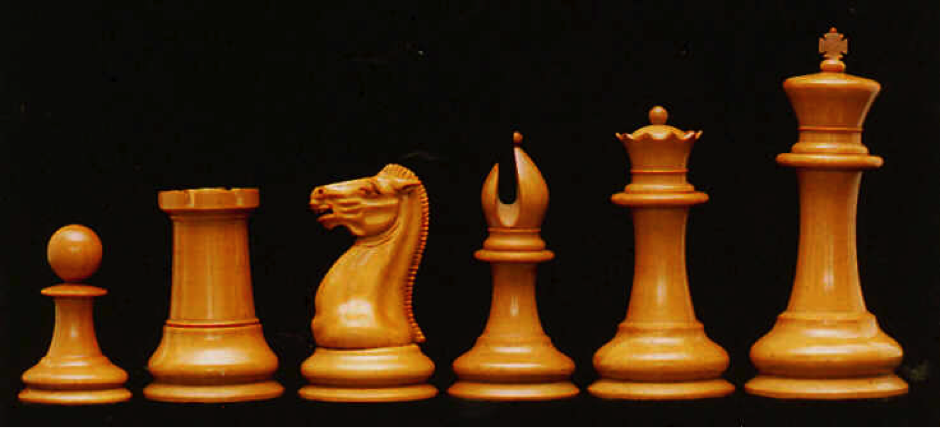


Staunton and Tournament Chess Sets

Although chess has been played for many centuries, tournament chess only developed after hundreds of years of casual play. The earliest recorded game of chess is from 1475, and was played in Valencia, Spain, between Francesco di Castellvi and Narciso Vinyoles. Tournament chess did not evolve until nearly four hundred years later, with the first major international tournament taking place in London in 1851.

staunton chess pieces

At this point in time, international tournaments will still rare. Chess players made little money, and, of course, the sort of international travel that we take for granted today was considerably more difficult to undertake. Consequently, the title of ‘Grandmaster’ was not a facet of the chess world at this time. However, another famous tournament that took place in the period was the first American Chess Congress, held in New York in 1857, which was won by the brilliant, but ultimately troubled, American Paul Morphy.

The London tournament was organised by top British player Howard Staunton. Staunton also had another significant influence over the game; he designed the eponymous Staunton chess pieces, which almost instantly became very popular.  This help to standardise chess sets especially for tournaments.

By the turn of the twentieth century, with several World Chess Championship having been held, tournament chess among world-class players was becoming considerably more common. The term ‘grandmaster’ was coined during the Ostend tournament of 1907, which featured such legendary names as Tarrasch, Schlechter, Janowski, Marshall, Burn, Chigorin, Rubinstein, Nimzowitsch, Tartakower, Mieses and Blackburne.

Today, Staunton pieces are common in every tournament standard chess set, and used in every grandmaster chess tournament. The chess governing body FIDE’s official policy is that “recommended for use in FIDE competitions are pieces of new Staunton style”.

Back in the Saddle

It’s good to be writing chess articles again. I own ChessBase now and a much-needed vacation seems to have left me thinking clearly. This is from a Game 35 at my local club.

Giofreda (1500) – Bland (1650) Norfolk, VA – 2012. 1-0

1. c3 Nf6 2. d4 d5 3. Qc2 {We are following Kamenetz-Ermolov, from the year
2000. The treatment by the expert who played this line is quite different than
the text here.} g6 4. Nd2 Bg7 {We are on our own. This is not in my database
of four million games. We do manage to transpose into familiar territory
however.} 5. e4 Nxe4 {exd is a stronger move. White’s queen is nicely
centralized after the knight capture in the text.} 6. Nxe4 dxe4 7. Qxe4 O-O 8. Nf3 {Every
game in my database contains Nd7 here. The plan in this game, c6 for black
followed by Bf5, is slow. The bishop is not terribly secure on that square either. Black can’t recapture with a pawn if I take the bishop since that leaves his king exposed.}

8… c6 9. h4 {Black’s kingside fortress can’t be assailed purely with pieces.} Bf5 10. Qf4 Nd7 11. Bc4 Nb6 12. Bb3 Nd5 13. Qh2 {While h4 is helpful in other respects, this is its main idea.} h5 14. O-O Nf6 15. Ng5 Ng4 16. Qf4 e5 {Black knows the important of the e5 square but this isn’t quite right.} 17. dxe5 Bxe5 18. Qc4 Qc7 {Black aims to eventually unpin his pawn, but he will need adequate defense for the f7 square}

19. Be3 Nxe3 20. fxe3 Rad8 21. e4 b5 22. Qe2 Bg4 23. Qf2 Bh2+ {This
drops an exchange or worse. The queen is overburdened with its defense of f7
and h2.} 24. Kh1 Bg3 25. Bxf7+ Rxf7 {This is forced. There’s a mating net on
the dark squares after Kg7.} 26. Qxf7+ Qxf7 27. Nxf7 {I am in time pressure.}
Rd2 28. Nh6+ Kg7 29. Nxg4 hxg4 30. Rfd1 {Wrong rook or right rook?} Rxb2 31.
Rd7+ Kh6 32. Rxa7 Bxh4 33. Kh2 Re2 34. Ra6 Rxe4 35. Rxc6 Re2 36. a4 bxa4 37.
Rxa4 {Black has traded off a few pawns and is close to drawing the game. My
opponent, also in time pressure, blundered his rook a few moves later.

Questions for examination:

Can black draw, despite the material imbalance?

Can black punish white for the opening’s timidity??

What are some of black’s strategic failures? White’s?


Come at me Bro!

In chess there are three situations one must manage. Broadly speaking, one looks after affairs of the board, the mind of the person in the opposite chair, and one’s own mental terra firma – I hesitate to call this counter-psychology since life itself, rather than the skulduggery of a particular opponent, often supplies the enervating influences that weaken play.

The majority of chess time involves board management, e.g, attempts to reduce weaknesses, limit unprotected pieces, and secure the castled position. Without such routine behaviors the game virtually cannot be won. Raw calculation takes place almost entirely within this sphere.

The second category is one to which many developing players pay heed. I know that against one particular opponent I will get a French or a Black Knight’s Tango as white, if I play normally. I don’t favor the long theoretical lines in either and I play 1. e3 for my first move. It’s a bit amateurish, but I know I can get the black side of the Scotch out of the deal. A tiny bit of awareness then helps improve my attentiveness during these encounters, all while building useful repertoire knowledge for the future.

The preceding is not to be taken to absurd measures of course, such as displaying unwarranted aggression or watching Nigel Davies’ forgettable ChessBase psychology video. The second group is far less effective when isolated from the other jobs of a chess player. Even Svengali, Mesmer, and Stanley Milgram would need elementary principles.

Thirdly, keep track of oneself. This begins away from the set and is a continuous process. Stop all disrespect as early as possible. I’m starting to think that ignoring mean-spirited criticism is not the heart of good interpersonal communication, as I once thought. It’s actually a cop-out. Let me be candid: There has to be some cognitive dissonance if I protect my own king, that is indeed the incarnate “me” on the chessboard – I suppose it must be if I’m willing to look after his needs above so few others for hours on end – more than I protect myself from verbal condemnation by strangers.

One absolutely cannot be a punching bag and play chess well. The option to let others infringe upon your self-respect can poison your life and not just cloud your chess thinking. Here is an example. I went for a run tonight and some people decided they were going to hassle a lone white guy for not wearing a shirt.

I am not trying to start a dialogue on racism because it’s a chess blog, but I get this type of thing a lot.  I finished my run, showered, and then went back to talk to them. After getting up in the dude’s grill we enjoyed some cognac together. Nice people actually.

We eventually settled into discussing why exactly you should consider the context of what you say to a minority. I am one in my area and people don’t hesitate to let me know it!  Everyone made themselves heard. I overreacted, they were racially insensitive etc. The truth was allowed to emerge about the man I am versus their perception of me. By asserting myself I believe I made self-respect easier the next time, shared a new viewpoint, and improved my ability to win chess games for the foreseeable future. Please feel free to write any positive feedback you might have on what I’ve said. Or negative feedback, because I’m that damn cold right now. I’ve got no shirt and nothing to lose, so do something!


Here’s the Hook

The following is a Game 60 I played on September 29th against a gentleman named Wu. The event was held at a junior high school that featured an adult tournament in the bowels of its gymnasium. The gym teacher surfaced at one point in a deep sweat wearing a shirt that read, “Hard work beats talent if talent doesn’t work hard.” Wait a minute…that’s pretty depressing.

The article title references the imaginary basketball shots a few players were taking in between games. I actually like to make an imaginary clang sound to help keep it real, or to impersonate a bigger more athletic defender against whom they are completely hopeless. Just as you laze into your uncontested three I come out of nowhere to destroy your rec-league level dream. Is this not basketball reality? As a lifelong basketball scrub I’m a little bit more modest when I shoot; I’ll sit at the the foul line and do my business from there. They call it the charity stripe for a reason. Now back to chess.

1. d4 d5 2. c4 e6 3. Nc3 Nf6 4. Bg5 Nbd7 5. cxd5 exd5 6. e3 Be7 7. Bd3 Nb6 {
White is hard-pressed to take advantage of this unambitious move. He should
play normally and resist the temptation to strike out right away.} (7… c5 {
This is a pretty promising continuation for black. Most QG Exchange
practicioners overlook these sidelines since they’re not deemed critical. This
one leads to a level game where white will concede the advantage as soon as he
runs out of ideas.} 8. Nf3 c4 9. Bc2 O-O 10. O-O) 8. Qc2 h6 9. Bh4 Ng4 {This
knight launch is interesting but flawed. It looks more like a clearing
maneuever rather than an attack.} 10. Bxe7 Qxe7 11. Nf3 Be6 12. O-O Nc4 {Black
has made a few weak moves and white has correctly stuck to his script. The
first player is much better, but wherein lies his advantage?} 13. Bxc4 dxc4 14.
d5 Bd7 15. e4 {Not seeing Ne4, a clearance move, white’s advantage diminishes.
I decide white’s “weak” pawn is defensible with the b5 pawn push and focus on
the center. This is an error in judgment.} O-O-O {The king is less safe on
this side. How should white play against the vulnerable king? Note that it is
hard to defend with pieces due to white’s control of d5.} 16. b3 cxb3 17. axb3
a6 18. Rfd1 Qd6 19. h3 Ne5 20. Nxe5 Qxe5 21. d6 {It looks better than it
really is. The prudent move is to ignore the pawn. Rook opposition is not what
white wants.} Bc6 22. dxc7 Kxc7 23. f3 Kb8 24. Kh1 {The position is equal now.
White has missed several opportunities to play b4.} g5 {This is a slow plan
but it challenges white to play actively. It’s a good psychological choice
because it reduces the time I have to find initiative. Black will surely get
his if I allow it.} 25. b4 h5 26. Ra5 Rxd1+ 27. Nxd1 Qg3 28. Qd2 g4 29. Nf2 {
These moves are seldom good. Rg5 is better. The move does not make it past the
candidate process.} gxf3 30. gxf3 {? White should be mindful about what he’s
giving up here.} Qxf3+ 31. Kh2 Rg8 32. Nd3 {This allows a mate in two. I
vaguely felt that the black queen could win on the dark squares. There’s no
excuse for missing this. Black throws the game away.} Bxe4 33. Qf4+ Qxf4+ 34.
Nxf4 f5 35. b5 {As abiding as my passion is for windmills I don’t really think
it’s intelligent to move the knight. I’m temporizing here since I’m low on the
clock.} axb5 36. Rxb5 h4 37. Rb2 Rc8 {I think my best chance is to go into the
knight/bishop endgame. It’s still losing for white but the endgame is pretty
primitive and I’ll be able to play it well despite my time deficit.} 38. Ng6
Rc2+ {Sometimes you get the benefit of an automatic move from your opponent.}
39. Rxc2 Bxc2 40. Nxh4 b5 41. Nf3 Be4 {This shifts the momentum. Avoid helping
your opponent move a piece hes about to move without prompting.} 42. Nd4 b4 43.
Kg3 Kc7 44. Kf4 Kd6 {What a terrible plan for black – and this is coming from
a guy who missed a mate in two not many moves earlier. It kind of looks like a
book ending. Black’s bishop is awful and the h-pawn is deceptively dangerous.}
45. h4 Kd5 46. Nb3 {This is a set-up from white. I’m hoping I get Bc2 here.
The king prevents the bishop from getting to the gleeful h-pawn in time.} Bc2 (
46… Kc4) (46… Ke6 47. Nd4+ Kf6 48. h5 Kg7 49. Kg5 Bd3 50. h6+ Kh7 51. Nb3
f4 52. Kxf4 Kxh6 53. Ke5 Bc4 54. Nd2) 47. h5 {! Eh, not even.} Ke6 48. Nd4+ {
My opponent offers me a draw here. He insists he knows it’s a draw. I think he
fails to look past the falling bishop.} Kf6 49. Nxc2 b3 50. Na3 b2 51. Nb1 {
The only move.} Ke6 52. Kg5 Ke5 {He fails to see the check in his calculation.}
53. Kg6 f4 54. h6 f3 55. h7 f2 56. h8=Q+ {My opponent gamely keeps playing.
You have to admire his pluck even if further play belies his winning chances.
Sometimes crappy half-court shots do go in but just don’t adjust your expectations to want a swish every time.


A Different Look at Unbalanced Endgames

Music and chess can mirror each other. In both we speak of tempo, subtext, and players with such technique it can become a living presence in the room. I picture the 1812 overture during development and a barrage of Motorhead when you king hunt, but no matter your disposition it’s not hard to see the strange rhythm in a chess game.

My good friend Michael, for whom I wrote an obituary on this site some time ago, made similar observation about games in general; although chess was not the subject I certainly think he’d concur with my thoughts. In my latest game I’ve decided to pick a song to go with my analysis. It’s found here. It’s called “Less Cute Version of You” and I think you’ll see why it’s apropos.


1. d4 d5 2. c4 e6 3. Nc3 Nf6 4. Bg5 Be7 5. cxd5 exd5 6. e3 Bf5 {We’ve analyzed
this line before. This is premature. If black could get away with such a move
there would be no reason to play aught else but the Queen’s Gambit Declined}

7. Qb3 O-O 8. Bxf6 Bxf6 9. Nxd5 {Not the best. Qxb7 will net two pawns.
Black will get a bit of play for them, but not adequate compensation.} (9. Qxb7
9…Nd7 10. Qxd5 {The queen is not all that vulnerable. When kicked to f3 it can exert a presence on the central light squares.})

9… Nd7 10. Nxf6+ Nxf6 11. Bd3 {We can say that a player gives up a move when his protected piece gets recaptured by another which is poorly placed on its new square. Fortunately, black turns tail and runs.} Be6 12. Qc2 c6 13. Ne2 Qa5+ 14. Nc3 Qg5

15. O-O Bh3 16. f4 {Black missed this resource.} Qg4 17. Kh1 Bxg2+ 18. Qxg2 Qxg2+ 19. Kxg2 Rfe8 20. f5 {? I didn’t defend the pawn. That was really an excruciating positional blow to me as well.}

Rxe3 21. Rf3 Rae8 22. Rxe3 Rxe3 23. Be2 h6 { Trading one pair of rooks isn’t such a hot idea if I can’t save a pawn while doing it. Now my king can intervene but it’s brutal trying to win with a knight for two pawns when the endgame is closing in quickly.}

24. h4 Ne4 25. Nxe4 Rxe2+ 26. Kf3 Rxb2 {After reaching this position I conceived of the column’s main point. Blatantly the knight is a less cute version than the three (perhaps two) advanced passers black can easily mobilize. I will not be able to use the knight to stop the blockading pawns and I will be forced to trade it for a pair. We are shuffling towards an easy draw for black if I am forced to play defense with the knight (not its forte)}

27. Nc3 Rc2 28. Ne2 {If black plays carefully the game is still relatively balanced. The knight is awkward.} b5 29. Rc1 Rxa2 30. Rxc6 {I did this to secure a passer of my own. I hope to use the knight as a blockader. My “less cute” piece is consigned to guard duty, a more fitting role than trying to stop black’s gargantuan passed pawns.} a5

31. Nc3 Ra3 {This is a critical position. To check or not to check? I do not want to check the king because its position on g8 may buy a tempo in a pawn race. It’s clear now that the rook is optimally placed there and my move is an error. Rd8 can defend the queening square and the c-file (if black’s pawn captures on c3).}

32. Ke4 {? A simpler plan but less effective.} b4 33. Nb5 Ra1 34. d5 {It’s best if black uses his rook to make the white king lose time.} a4 35. d6 Rd1 36. Nd4 b3 37. Rc8+ Kh7 38. d7 b2 39. Rb8 b1=Q+ 40. Rxb1 Rxb1 41. d8=Q a3 42. Qa5 Ra1 43. Kd5 a2 44. Nb3 Rh1 45. Qxa2 Rxh4 46. Nd4 Rh1 47. Qa7 1-0

I went on to win but I should have seen the stock dropping on my knight far earlier. An advantage in material is the most flexible of all imbalances but it cannot by itself lead you to exclude qualitative assessment of a position. “Just trade pieces when your up” is rather reductionist not to mention misguided!


Tools for Freedom

I just encountered one of those eschatological catalogs which sell anti-radiation glasses and tools for stopping the encroachment of the federal government. I’m not exactly Randy Weaver but I do love a good magazine with a giant, burning dollar bill on the front. It was good for a chuckle, for its novelties which may surface as details should I capitulate and churn out my generation’s The Road, and for a few historical tidbits. For instance, the subject of this chess article, Agenda 21, that is the benign United Nations plan for keeping our planet healthy- or, as Tools for Freedom would have it, the crucible for engaged citizens everywhere.

So I’ve decided to institute my own Agenda 21 for chess, and I encourage you to do the same. No, it’s not a global spying ring operating under the guise of assisting the poor. It’s going to be a plan for improvement in my chess life, beyond where I suspect I’ll go despite dint of hard work and interesting ideas. Everything happens because somehow deity, or perforce mankind, decided to systematize things. Chaos began all things but letting it manage things is a bad idea. I’m going to reach into the whirling maelstrom of my chess mind and create some order up in there.

Right now I rarely win at club level; I lost a pawn ending last night so dishearteningly easy to draw that it looked like a helpmate problem. That’s okay because I’ve got a lot of pluck! I’m taking positive steps to see where I go wrong and am looking at the mistakes made at the higher levels as well. Everyone has leaks in their game that cost them rating points. I prepare sparingly, overestimate others, and am not even slightly in love with the hard-nosed aura that seems to surround good chess athletes. Losing habits, all of them.

The analogy I’d like to make is that of a stalled ship. Ultimately it’s staying in port until the anchor’s lifted, but solving that error doesn’t mean the boat’s fit for the seven seas. Sometime soon there are barnacles that need reckoning. The crew’s wages can’t be in arrears or the captain will have a mutiny on his hands. The supply rooms better be stocked and mouse-free too.

It’s tempting to solve only the biggest issues first, the giant metal chain tethering you to your circumstances for instance, but tackling things in descending order of importance can’t be the best practical try. There’s got to be a better way. That’s what my Agenda 21 will feature.

Now this isn’t completely my idea. Jesse Kraai had something similar in one of his lectures, probably in the archives of chesslectures.com, a while back. He encouraged us to make plans based on the success of other plans. Fundamentally this is an amazing resolution, to make a map of a place you’ll never reach.

At first it seems the high point of idiocy to compound one hazy view of the future with an even mistier view to the land beyond. Sure, I get it; on a chess board a rank amateur can calculate forcing sequences but in life we can’t control what gets in our way. However, when serious obstacles emerge your defining idea can’t be the thing in front of you but the beautiful places that lie on the other side.

Why isn’t Magnus Carlsen 2900 FIDE yet, a threshold that is unreachable only until it happens? Has he not gotten around to hiring a captain with two good eyes yet – maybe that’s why the boat is going in circles.


Thoughts on a Novel Approach

When I first encounteredThe Final Theory of Chess I was in the library looking for materials on cultural geography for a research paper. Spying the book from the corner of my eye, I wasn’t sufficiently motivated to open anything with such a title. Attempting the final analysis on anything reeks a bit of hubris doesn’t it? I found out later that the book is meant as a first step of sorts, and the actual title is more marketing ploy than chess death knell.

A few years later I’ve paid the book its due, and I find it intellectually honest as well as ambitious. The information is available in Wiki form available here. Part of my aversion to reading the book had been based on concern; any claim that the game I love will soon exist only in diminished form really shakes my tree. I came to chess later in life than most, and I don’t want to miss out on the process of incremental discovery that makes the game so rewarding.

The book’s principal idea, that chess is often a draw, one drawing line is claimed to be as good as another, makes solid theoretical sense, but may not necessarily be based on practical chess scenarios. Why might you need an expansive repertoire when it serves the same functionality as one that’s learned more easily?

1) Putting your opponent through the psychological paces can help you win a tournament!

2) You want to make your opponent go through the crucible of your preparation. Pose him interesting problem he’s not likely to have studied because they’re beyond the practical limits of what a chess player can do.

3) Good old variety.

4) To keep championship chess from continuing on the path it’s going down. We already see how a few lines dominate and fortune favors those champions who take few risks. If you could solve chess it wouldn’t be beneficial for the future of the sport at the highest levels (no doubt a determinant of how the game appears to chess mortals).

All this isn’t to say that going through the hundreds of pages of FTOC theory is easy; there are mind-boggling positions in the repertoire provided. Sometimes you want to stick with a particular chess theme and if you’re going to sit with a stranger for six hours you may as well indulge yourself to the extent the game lets you!


A Common Opening Error

The game below features a really common line in net chess. Black is doing well right off the bat but he risks being worse if he does not use his favorable imbalances (bishop pair and better central control). On the black side, and that’s the only side you should play, watch out for early missteps by white that expose his uncoordinated material. I missed one here that would have wrapped the game up earlier than I did.

1. e4 e5 2. Bc4 Nf6 3. Nc3 Nc6 4. Nf3 Nxe4 5. Bxf7+ Kxf7 6. Nxe4 d5 7. Neg5+
Kg8 8. Nh3 {? Doesn’t look terrible as it anticipates h6. It actually loses.
The tactics are brutal! The finish is hard to see but what about the motif
black must use?} Be7 (8… Bg4 {This wins a piece after a crazy forced
sequence. This line comes up a lot in net chess so it’s worth remembering.} 9.
d3 e4 10. dxe4 dxe4 11. Qxd8 Rxd8 12. Nd2 Nd4 13. O-O Ne2+ 14. Kh1 Nxc1) 9. d3
Bg4 {Late to the party} 10. Qd2 Qd7 11. Qe3 Bxf3 (11… Nb4 12. Qxe5 Nxc2+ 13.
Kd1 Nxa1 {It looks like black has the problems but so much of chess is about
balancing offense and defense. One cannot count on winning material without
defending. A capable player will make you pay for your material advantage.})
12. Qxf3 Rf8 13. Qg3 Rf6 14. Bg5 Rg6 15. Qe3 Bxg5 16. Nxg5 h6 {Qg4 is better,
to set up the battery} 17. Nf3 Rxg2 18. Nxe5 Nxe5 19. Qxe5 Kh7 {If black isn’t
careful he could be in for a long game.} 20. O-O-O Re8 21. Qd4 Re2 22. Rd2 Rxd2
23. Kxd2 b6 24. c4 Qf5 25. Rf1 dxc4 26. dxc4 Rxh2 27. Kc1 Rg2 28. Qe3 {
Jockeying for position. White should look for ways to keep pieces on the board.
The best defense is to keep both heavy pieces on the board.} Qg5 29. f4 Qg6 30.
Qc3 Qf6 31. Qd3+ g6 {This moves looks premature. What good is weakening the
king when the pawns aren’t advancing any further? This also necessitates
covering the h7 – b1 diagonal with a piece.} 32. Qd7+ Qg7 33. Qb5 Qd4 34. Rd1
Qxf4+ 35. Kb1 Qe4+ 36. Ka1 Rd2 37. Rf1 Qe6 38. Qb4 Rd7 39. Re1 c5 40. Qc3 Qf7
41. a3 Rd4 42. Qh3 Rxc4 43. Rh1 Qg7 44. Qd3 Rd4 {I’m not making any progress.
Do I play against the king by weakening white’s queenside pawns?} 45. Qc2 Qe5
46. Qc1 Qf4 47. Qe1 Qe4 48. Qc1 Qf4 49. Qe1 Qf7 50. Qe3 Qg7 51. Kb1 g5 52. Rf1
Qg6+ 53. Ka1 Qg7 54. Qe6 Rf4 55. Rd1 Rf6 56. Qe4+ Rg6 57. Rd6 Qf7 58. Qd3 h5 {
Of all times to play this…I totally forget about the pin on my queen. It’s
playable but not pretty.} 59. Rd7 Qxd7 60. Qxd7+ Rg7 61. Qf5+ Kh8 {It’s just
passive. There’ll never be an opportunity to move the pawns to their
destination. The king can approach while black remains in virtual zugzwang.}
62. Kb1 h4 63. Kc2 Kg8 64. Kd3 g4 65. Qd5+ Kf8 (65… Kh7 66. Qh5+ Kg8 67. Qxh4
g3 68. Qc4+ Kh8 {A very interesting try! I dismissed the line after seeing
that it dropped material. Always calculate to the end!}) 66. Qf5+ Kg8 67. Qc8+
Kh7 68. Qf5+ Kh6 69. Qf6+ Kh7 70. Qxh4+ Kg8 71. Qg3 Kh7 72. Ke4 Kg8 73. Kf5
Rf7+ 74. Ke6 Rg7 75. Qb8+ Kh7 76. Kf6 Rg6+ 77. Kf5 Rg7 78. Qg3 {It seems easy
to draw this with passive defense although the computer thinks this is not so.
Watching an engine match involving this ending would be quite illuminating,
and is worthy of a future write-up.} Rf7+ 79. Ke5 Re7+ 80. Kf6 Rg7 81. Qh4+ Kg8
82. Qh6 Rf7+ 83. Kg6 Rb7 84. Qh4 Rg7+ 85. Kf6 Rf7+ 86. Ke6 Rg7 {With time on
my side I need to be careful of perpetual check. My opponent has mere seconds
remaining.} 87. Qd8+ Kh7 88. Qf8 g3 89. Kf6 Rg6+ 90. Kf5 g2 91. Qf7+ Rg7 92.
Qh5+ Kg8 93. Qe8+ 0-1


A Really Beautiful Line

I just came across the well-regarded radio match, Denker-Botvinnik, played in1945. It’s really colossal and I only wish my ability as an annotator were up to snuff. One striking feature here is the extent to which Rybka agrees with Botvinnik’s choices. To have scored above eighty percent during a retrospective analysis, in an era when an engine itself could not be consulted, indicated an unusual instance of profundity – even for a world champion. We all know Botvinnik was capable of utilizing a brilliant imagination, but here we see through to the skeleton of his fundamentals.

I need to learn the Botvinnik System to the Anti-Meran Gambit for my preparation as both white and black. If you follow the link you’ll see the gambit begins with Bg5. Looking a bit down the line black will be a pawn better. Further, it’s much clear. The first eleven moves, the territory with which we’re concerned, are really a microcosm of all the known theory. We know what the moves are but neither man nor silicon can tell the true story of what’s happening.

5…h6 is fine but both sides lack winning chances if white gives up bishop for knight. It’s not that this is a bad line, but the Botvinnik system preserves chances for both sides to get the full point. To some extent you are in league with your opponent during the opening; you must guide each other toward positions where each player can prove himself.

Dismissing the callow h6, play proceeds with white challenging the center and black’s newly-minted c-pawn. High-level chess is about the weight of one advantage against another, here the center against a material advantage.

Next, look at how black can tactically justify the immediate b5. It’s mostly a forced sequence, deviations like 8.Bxf6 lead nowhere. Black’s many dark-squared weaknesses are hard to exploit without the corresponding bishop, not to mention the move loses material.

The e5 pawn is used to punish the knight and grant white material superiority.This imbalance also has a price tag attached; black’s light-square bishop, usually with more than a tinge of Howard Hughes to it, promises to be quite powerful after the c5 break. It will oppose white’s bishop which goes (though not in this game) to his long diagonal.

Can you pinpoint where white’s game falls apart? If you can’t, and if you can then there are blogs which will remind one far less of bicycle training wheels, then that probably means you’re at a tabiya worth playing. We have a rich position here, the merits of which are still hotly debated. I recommend playing this position for both sides and putting your imagination and technical still to the ultimate test. I know I will with the Botvinnik Variation to the Anti-Meran Gambit.

I would be remiss if I omitted the transpositional qualities of the opening. Black can steer white into a Cambridge Springs or Orthodox Queen’s Gambit with Nd7 or Be7 (vice dxc5). If you fear these lines as white, having learned them for black I am convinced they are excellent for the second player, then I hope you’ll find the preceding theory useful. You’ll find plenty more of it in the database to which I’ve provided a link. Happy hunting!

Scroll to Top