Uncategorized

The Full Spectrum

This is from the final round of the Virginia State Champs. I had 2.5 points and was fighting for first. My opponent was Caijun Luo; he was rated 1700 USCF before this tournament. He was not in top form during this game. Note: I’ve mostly used the past tense here but chess belongs in the historical present; I suppose I deviated here for aesthetic reasons. I felt like I was was part of something virtually fait accompli, fully alive and in charge of my own destiny – it was my game to win or lose. I don’t normally feel that way but I suspect that good players often do.

1. e4 e5 2. Nf3 Nc6 3. Bb5 a6 4. Ba4 Nf6 5. Qe2 {I’d never seen this move
before. It’s called the Worrall Attack. It is not critical due to its rarity
and the simplicity of fighting against it. Schiller plays it to good effect
however. See his game at http://www.chessgames.com/perl/chessgame?gid=1335688
This denied me the Open Lopez lines, and I’d forfeited the opportunity to play
the Bird Defense however.} Be7 {Bc5 gives white some issues because the d4
push isn’t so easy.} 6. O-O d6 7. c3 b5 8. Bb3 O-O 9. Rd1 Na5 {White could
have had d4 in exchange for a great piece.} 10. Bc2 c5 11. d3 Re8 12. Nbd2 b4 {
This was bad and I knew it at the time. White’s pieces were poised for an
attack that looked to be long-lasting and ferocious. I was willing to create
some weaknesses in order to establish my own activity.} 13. Nf1 bxc3 14. bxc3
Bd7 15. Rb1 Rb8 16. Bg5 h6 17. Bh4 Nh7 18. Rxb8 Qxb8 19. Rb1 Qc7 20. Ne3 {
Never in a month of Sundays did I imagine I’d get to trade off the bastard son
on e7. I suppose white was eager to trade off one of my defenders. He was
missing pawn play however.} Bxh4 21. Nxh4 Rb8 22. Qd1 Rxb1 23. Qxb1 {I was
fine by this point. Around this time my competition for first place had
offered a draw to his opponent. I took that as kind of a slap in the face; he
was sitting right next to me and did not think I had a chance to win or draw.}
Nf6 24. Nhf5 g6 {My first real mistake of the game. I can’t trap the knight
like I supposed. Can you see why?} 25. Ne7+ Kg7 26. N3d5 Qb7 27. Qxb7 Nxb7 {
White’s position seemed superior but it is eminently reasonable for black.
Black’s bishop was a great piece.} 28. Bb3 Na5 29. Nxf6 Kxf6 30. Nd5+ Ke6 {I
was happy about this move. It’s probably as close as I’ll ever come to a real
“!” but since it isn’t strictly necessary I can’t apply that much sought-after
label. I’ve never moved into double check willingly!} 31. Nc7+ {I exhaustively
examined all of the variations during the game and determined white should
repeat.} Ke7 32. Nxa6 {? My opponent was extremely tired and did not allow
himself to check the lines over again. At an amateur level it’s often wise to
ignore Kotov’s advice and check your work.} Nxb3 33. axb3 Bb5 34. Nc7 {This
can’t be held with best play from black. I draw a lot of these but my play has
been insulted by two people in as many hours. I’m winning this one.} Bxd3 35.
Nd5+ Ke6 36. f3 f5 {I tried to create a weak pawn.} 37. Kf2 (37. exf5+) 37…
fxe4 38. Ne3 d5 39. fxe4 Bxe4 40. g3 h5 {Not the best. The plan was to lock up
the pawns in order to create zugzwang. Knights can’t lose moves.} 41. h3 g5 42.
g4 h4 43. Nf1 Bc2 44. Nd2 d4 45. cxd4 exd4 46. Ke2 Ke5 {White was forced to
give way.} 47. Nf3+ Kf4 48. b4 d3+ 49. Kf2 cxb4 50. Nd4 {Allowed d2} d2 51.
Ne6+ Ke5 52. Nxg5 d1=Q 53. Nf3+ Qxf3+ 54. Kxf3 b3 * 0-1


Ghosts: Inside the Bestiary, Part One

Some ghosts serve their creators as carriers of transcendental truth, as visible or audible signs of Spirit. Other ghosts carry the burden of tradition and collective memory…ancestral apparitions often act as correctives to the insularities of individuality, as links to lost families and communities, or as reminders of communal crimes, crises, cruelties…. – Lois Parkinson Zamora Magical Romance/Magical Realism: Ghosts in U.S and Latin American Fiction

All tournament-goers believe in ghosts; threats that hold no true power. There’s a moment in every game where the limen between the real and unreal fades to nothing. Amateurs make minor concessions when not required, and surrender initiative without reason. True to the quote above, what we see in front of us is our own history- warped by past mistakes. Let’s get cozy with our cast of ghosts, in ascending order of malevolence. Later we’ll talk about how we can bust these phantasms like they deserve.

Casper the Friendly Ghost: It is a harmless one-mover without an ulterior motive. It drifts from move to move “booing” for no good reason. If your opponent is Casper, you can often use the inclination to chase you to your advantage. Keep your position fluid and open. Casper hopes that by making you move you’ll eventually slip up and give him a tactic with which to win. This is its only power.

The Headless Horseman: This one is a bit more dangerous. Its cognition is not fully there , being, sans head, but HH certainly is aggressive. Don’t worry about subterfuge; creation of a hole or another strategic weakness is not the goal. Material is the focus. The Headless Horseman baldly tries to pick on your overworked pieces, pieces that share one another’s squares, or lack of space. HH sees weaknesses even though it finds them difficult to exploit; it is terrible at creating multiple threats to undermine your defense. HH will pile everything but the kitchen sink onto an isolated pawn when he would be better off using the opponent’s immobility to attack another area. Naturally the more you respond to this knight errant the more powerful he becomes.

Ghost Dad: Bill Cosby played a father with a heart of gold, killed by a taxi-driving maniac. He has only a few days to become a better person and straighten out his priorities. His motivations are sincere and he has a definite plan to get a favorable result. Ghost dad threatens to use your vulnerabilities to aid his development, plunges his h-pawn forward, and plays a4 after you play a6. Not only does he make threats but he anticipates your responses. He is willing to consider positional aspects to achieve his goals.

Frederick Krueger – More intimidating than the previous because like a true ghost he gets into your head. In fact if you don’t wake up soon from the dreams he inspires you’ll certainly be lost. Kreuger inspires phatasmagoria and an inability to know which parts of the onslaught are real and which are fake. Robert Englund’s serial killer can stay with you between games and scare you whenever you see his likeness.

A Chess Concept

I was rereading Beowulf the other day and I found a kenning I really liked. This literary convention, ancient in origin, replaces a single noun with a compound one; arguably the most famous kenning is “whale-road,” meaning the sea. The one that really struck me was for a king, “breaker of rings.” The king of old was first and foremost a patron. He kept his retainers in check with wealth, giving bits of gold from his rings to reward loyalty.

As chess players we understand that our “slow-walker” has got to know his limits. One such situation is in queen endgames. Although there is but one piece to each side, a naked king will usually shift the position’s balance. In skittles chess the other day I saw my opponent erect a defense I could not solve. Now I know its value, but not how to undermine it. Perhaps you will face the same quandary. Examine the pictures provided and comment on your impressions of the positions.

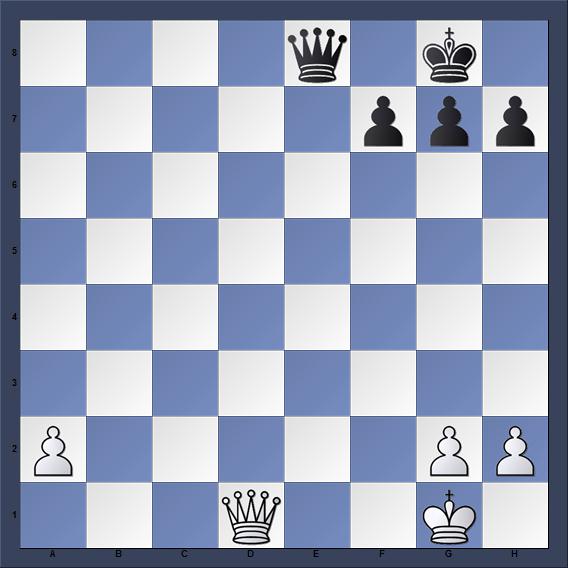
The starting position is below, before my opponent implemented his plan. I’m white. I failed to realize the potency of black getting his pawns on one color (f7, g6, h5) and using his king to protect the weak squares in the formation. He set it up without an issue and I eventually made a strategic error. I did not want to move my own pawns to weaken his position, and tried to rely upon piece play alone. How would you have proceeded?

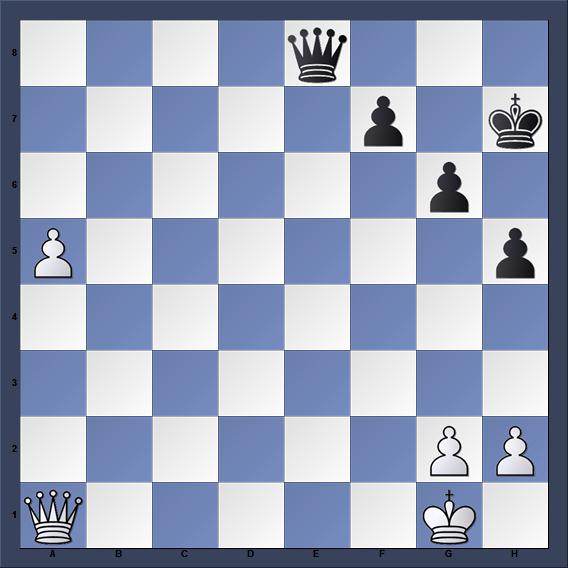
In the diagram below I’ve made progress but don’t know the promotion plan. Once my pawn gets to a7 how do I move my opponent’s queen? By intervening with my pawns and/or king I may set up a check that will allow black’s queen perpetual check. Does white’s king hide (if he can) or participate in the promotion of his pawn? I can’t imagine the latter option would work.

It should be noted that the only pure-queen endgames worth studying involve asymmetrical pawn structures. Had three pawns been on the same side the threat of opposing queens would have made defense a breeze.

Anything but Slight

You probably expect that I’m moralizing and self-righteous in real life, judging from the amount I go to the “civilization depends upon us being nice to one another” motif. Sandy Koufax had his four-seamer and I guess have my go-to pitch as well. I wasn’t planning on broaching this subject again, until something odd happened to me in the fourth round of a club tournament. My opponent and I were undefeated and I congratulated the young man, “Nice job on winning three in a row.”  Without missing a beat he deadpanned, “I’m about to make it four.” I haven’t been so taken aback by six simple words since, “Ahh, honey I’m late this month.”

So, now the game in front of us took on a different dimension. We play chess in a Jewish Temple, nice folks let out some space for us every Tueday. The divide that rose up was rawer and more expansive than old Moses’ Red Sea. Showdown in the Synagogue, The Beth Messiah Brouhaha, The Rabbi’s Rumble – I don’t know what you’d call it, but all I know is, shades of Rocky V, “My Yeshiva is in the street!”

I have been dismissed by few people as coldly as by that nine year old. Still, if he wanted to win he was going to have to go through me. You don’t talk back to Bad, Bad Leroy Brown, you don’t dance with the devil, and you don’t tug on Superman’s cape.That “S” on my chest may stand for “slow-mo” most of the time, but tonight his words left my ego a pus-filled wound. I became very motivated. I stood there in the brackishness of it all and I felt as Gaius Muzio Scaevola must have, his hand over the brazier.

1. d4 d5 2. c4 e6 3. Nc3 Nf6 4. cxd5 {I’ve been messing up this move order for
as long as I remember. Making the exchange early denies white the b1-h7
diagonal. He should get a piece on it before black. If black wants to seize it
white ought to make him spend time on g6 first.} exd5 5. Bg5 c6 (5… Bf5 {
This is the reason why the other move order, with an early Qd2, is better.
Black doesn’t have any problems, except of course f-pawns that can become
isolated and doubled.}) 6. Qc2 g6 7. e3 Bf5 8. Bd3 Bxd3 9. Qxd3 Bg7 {The light
squared bishop wasn’t that important. The Indian Formation makes it less
useful. White must take care to keep black’s bishop looked up at all costs. C5
from black needs to be calculated out every time white moves.} 10. b4 {
Beginning the minority attack. It’s a relief to not even have to prepare the
move with a3 or Rb1!} Qd6 11. Rb1 O-O 12. Nf3 Nbd7 {Black needs to get that
knight to c4} 13. O-O Rfe8 14. Bf4 Qe7 {Black sometimes sacrifices a knight in
these positions to pry open the king. This is usually after white plays f3 for
central space.} 15. Rfc1 Ne4 16. b5 Qa3 17. bxc6 bxc6 18. Nd2 Nxc3 19. Rxc3 Qe7
(19… Qxa2 {I wish!}) 20. Rb7 Qe6 21. Ra3 a6 22. Rc7 Reb8 23. Rxa6 Rxa6 24.
Qxa6 Rb2 25. Nf1 Bf8 26. Qxc6 Qxc6 27. Rxc6 Rxa2 28. Bd6 Bg7 29. Rc8+ Nf8 30.
Bxf8 Bxf8 31. h3 Kg7 32. Ng3 Ra1+ 33. Kh2 Bd6 34. Rd8 Bxg3+ 35. Kxg3 Ra5 {I
admit that I should not have gone to this endgame. Everything’s on the same
side and I shouldn’t have won.} 36. h4 Kf6 37. Kf4 Ke7 38. Rh8 h5 39. Ke5 f6+
40. Kf4 Ke6 41. Rg8 Kf7 42. Rd8 Ke6 43. Rc8 Ra2 44. Kf3 Ra6 45. g4 hxg4+ 46.
Kxg4 Ra2 47. Rc6+ Kf7 48. f3 Ra3 49. Rc7+ Ke8 50. Rg7 Rxe3 51. Rxg6 Rd3 52.
Rxf6 Rxd4+ 53. Rf4 Rd1 {I think my chances have improved. What is the king’s
role? How about the rook? Is it enough to keep black’s king out? There needs
to be some sort of finesse in order for the extra pawn to be conclusive. I
benefit from black’s inability to exchange down to a single pawn. If black’s
pawn were on the e,f,g or h files the road to a draw would be simple. Rook
endgames can sometimes be about qualitative factors rather than quantitative
ones (material).} 54. Kh5 (54. h5 {?} d4 {Black’s rook can harass the king
until he abandons the h-pawn.} 55. Kf5 {Avoiding the perpetual but losing time}
d3 56. Rh4 d2 57. h6 Rb1 58. h7 {Black to move and draw. Try this puzzle, but
be careful. White has some mate threats on the radar.}) 54… d4 55. Kg5 {The
only move. After Kh6? …Rh1 black gains time since white’s pawn defense is
obligatory. Black also gets his rook out of the way of his charging pawn.} (55.
Kh6) 55… d3 56. Re4+ Kf8 57. Kf6 {I’m hinking of mate threats from the side.
At least black will have to make a king move; I’m running low on time and this
is simple a spite check so I can get my bearings. Rf1 ends my night of chess.
It’s a dead draw.} Rf1 58. Rd4 Rxf3+ 59. Kg5 d2 60. Rxd2 {1/2/ 1/2} *


The Gentle Art of Persuasion

The last time I wrote, the material concerned Gurgenidze-Spassky from the fifties. I’d like to follow up that effort by showing you a game of my own, and one that I think is already being spoken of in hushed tones wherever chess is played. I have the white pieces, but not for long due to the battle’s quick culmination. My analysis is that my opponent’s nerves did not have the rigor to withstand my plucky strategic conceit in the opening. Daunted by the prospect of continuing play against an actual chess author my opponent, ostensibly looking for Chess.com’s resign button, mistakenly offered a draw on move five.

Now I chuckled a little bit at his temerity. My rating is high enough so I don’t bother to politely decline. A scoff or a wry “WTF?” are all I need to convey my point. Etiquette is for people who don’t know chess, as any visit to a club tells you. Feel free to cry in Miss Manners’ lap because you don’t know the KID thirty-five moves deep, but when you come back to the board you’ll still be a patzer. Do you see me laughing? I’m regaling one of my lady friends with a tale of you once calling your mate in three a brilliancy, and she’s very impressed. Unfortunately she only dates titled players.

For those of you without a Slavic last name, an ability to spout precise valuations without a board – make that without owning a board, and a gift for standing over someone else’s board and speaking to them insufferably during their analysis, you don’t need to study the actual chess game that’s about to follow. This is like the red rope and I’m the chess bouncer. Somebody big is here, like Kanye or something. Now that we have people of a reasonable pedigree around we can continue.

1. e3?! Not theoretically an error but it is unambitious. If anyone else played this I would put a question mark on the move without hesitation, pity, or tinge of moral compunction. I wouldn’t just mark your score sheet with the symbol of your futility but I would write the number to a psychiatrist below, which I only have handy because I so routinely meet people inferior at chess.

Nonetheless I can get a French or QID Reversed, a Colle, or Larsen’s Opening out of this. All out of 1. e3! Actually, I can get anything I want because this one transposes to everything on move thirty-four. Oh, that’s not in Eric Schiller’s latest treatise? Poor guy.

1. e5: Black plays to exploit white’s failure to seize the center. It’s only a failure if you do something for which I have not accounted. The early e3 will keep the light-squared bishop locked away for a while, but that’s only to deceive you into committing to the dark squares so that I can bring the pain. I must look positively foolish when I win before presenting the strategy in full. Please trust me that the end would have been superb – for my ego.

2. e4 …Bf5: I’m black now and am probably going to transpose into a Two Knights or Italian Game.

3. Nf3…Pressuring the doomed e-pawn with aplomb, while developing a piece at the same time.

3…Nc6: Can a person be out of book when they do not own one? Philosophical riddles are all I am going to leave my opponent.

4. Ng1!? An offer of repetition. 1/2 – 1/2

So that’s the game. I hope you’re enlightened. You should be glad to learn that Everyman Chess, somewhere and some time, will dedicate one of its Starting Out books to you. Don’t be modest since you so truly deserve the honor.

Oh, if you’re wondering why this game was played so poorly: my computer, or the chess site’s server, wasn’t letting me drag the pieces to the right spots. I figured I’d roll with it 🙂

The Whole Board

This one is a bit of a stinker by any technical standard; it does feature several creative flourishes in the notes however, found afterward by the silicon genius. The lesson for today is short and simple: be situationally aware at all times, using the whole board. The hidden key to springing a tactic can often be found in a different quadrant than the one on which you’re focused. It is a Game 30 and I’m playing as black.

1. e4 e5 2. Bc4 Nf6 3. d3 Bc5 4. h3 O-O (4… c6 {Black can effectively play the white
side of the Italian Game in which h3 is useless.} 5. Nf3 d5 6. exd5 cxd5 7.
Bb5+ Bd7 8. Bxd7+ Nbxd7 9. Nc3 e4 10. dxe4 dxe4 11. Qe2 O-O 12. Ng5 h6 13.
Ngxe4 Nxe4 14. Nxe4 Re8 15. O-O Qh4 {Black has to be careful to make the most
of white’s knight problem.}) 5. c3 a6 {This wasn’t necessary; the real benefit
of a6 comes from being able to preserve the bishop from being exchanged for
the queen’s knight. White may choose Nd2-f1 instead and allow black to delay a6.}
(5… d5 {Both lines given here give black a great game.} 6. exd5 c6 7. dxc6 (
7. d4 cxd5 8. dxc5 dxc4 9. Qxd8 Rxd8) 7… Nxc6 8. Nd2 b5 {Exploiting the
weakness of the f2 square.} 9. Bxb5 Bxf2+ 10. Kf1 {?! Not markedly different
than capturing the bishop, though this is a bit unexpected.} Ne7 11. Kxf2 Qb6+
12. d4 exd4 13. cxd4 Qxb5) 6. Nf3 d6 7. Nbd2 Nc6 8. a4 h6 9. b4 Ba7 10. Bb2 Be6
11. b5 Na5 12. Ba2 Bxa2 13. Rxa2 {…Nh5-f4 is good here because the dark
square bishop is off its home diagonal. This one of the reasons the bishop
infrequently visits b2.} c6 14. bxc6 bxc6 15. Nh4 Nxe4 {Wins a full pawn.} 16.
Nxe4 Qxh4 17. Qf3 d5 18. Ng3 e4 19. dxe4 dxe4 20. Qh5 Qxh5 (20… Bxf2+ {! A
beautiful temporary sacrifice. One would need to see that f3 is under black’s
control. I considered it, because it’s forcing, but didn’t understand it’s
true value. The rook is shut out too.} 21. Kxf2 Qf4+ 22. Kg1 Qxg3) 21. Nxh5 c5
{The plan is correct, control c4, but there’s no reason to make two pawn
moves when the knight is immobilized.} 22. O-O c4 23. Re1 f5 24. Bc1
Rfd8 25. Ng3 g6 26. Bxh6 Rd3 {I thought to win a pawn here on c3 and secure a
passer. In my initial evaluation I underestimated his defensive resources.} 27.
Ne2 Nb3 28. Nf4 Rxc3 29. Nxg6 Kh7 30. Ne7 Kxh6 31. Nxf5+ Kg5 32. Nd6 {An
interesting sacrifice. White has many resources available despite being down
material.} e3 {I missed a resource and this is a blunder. I did see the knight
fork, but what I didn’t see was the ability of the a7 rook to interfere with
the plan.} 33. Ne4+ Kf4 34. Nxc3 exf2+ 35. Kf1 (35. Rxf2+ {Doesn’t even
warrant an exclamation mark, should have been easy to see for both of us.}
Bxf2+ 36. Kxf2 {White has two connected passers in the vicinity of his king.
This is tricky for black.}) 35… fxe1=Q+ 36. Kxe1 Re8+ 37. Kf1 Be3 38. Nd5+
Kg3 39. Re2 Rf8+ 40. Ke1 Bd2+ {Visions of checkmate danced in my head!} 41. Kd1
Rf1+ 42. Kc2 {It may be simpler to just win material with the pin…} Rc1+ 43.
Kb2 Bc3+ {? Bishops enjoy their checking distance too! What a terrible
blunder!} 44. Nxc3 Rg1 45. Re4 {?} Rxg2+ 46. Ka3 Kxh3 47. Rxc4 Nd2 48. Rc6 Rg3
49. Kb2 a5 50. Rc5 Rg2 51. Kc1 {?? Loses to the fork} Nb3+ 52. Kd1 Nxc5 53. Nd5
Nxa4 {!? Allowing yet another fork seems fitting somehow.} 54. Nf4+ Kg3 55.
Nxg2 Kxg2 56. Kc2 Nb6 57. Kb3 a4+ 58. Ka3 Kf3 59. Kb4 {Black must remember not
to get the pawn to the 7th rank before preparations are taken.} Ke3 60. Ka3 Kd3
61. Kb4 Kc2 62. Ka3 Kc3 63. Ka2 Nc4 64. Ka1 Kb3 65. Kb1 Na3+ 66. Ka1 Nc2+ 67.
Kb1 {Remember the bishop and knight endgame? The winning side must start by
controlling the corner.} a3 68. Kc1 a2 69. Kd2 a1=Q 70. Kd3 Qa6+ 71. Kd2 Qd6+
0-1


Idiographic vs. Nomothetical Ideas in Chess: Part Two

I have been notoriously inconsistent with the second part of any blog I divide into parts. My whimsical nature means new fancies and a new indentured servitude to this moment’s fashions. Nabokov told us, “Existence is a series of footnotes to a vast, obscure, unfinished masterpiece.” Still I know it’s a bit of a cop out and a shame when a part deux never materializes. This one’s for my grandfather, for whom the Korean War was just a giant after party – with some killing thrown in ; we think he’d have gone after any belief that had “ism” as a suffix…

Here’s a game I played online at the usual time control of Game 30. It features another sideline to the Albin Countergambit. This time I made my emphasis for the game “challenging beliefs”. I did my best to try nothing but concrete evaluations. A regular Kasparov!

1. d4 d5 2. c4 e5 3. dxe5 d4 4. Nf3 Nc6 5. e3 Bb4+ 6. Bd2 dxe3 7. fxe3 Qe7 {
The problem with this move is that white can get in Nc3 instead of Nd2. Nd2 is
an important concession for black (if the queen captures on d2 it will have to
move again and cost white time). Although pressure on the e5 pawn is the plan,
and Qe7 is called for, move order is still important.} (7… Bxd2+ 8. Nbxd2 Nh6
9. Qb3 {Knights are very good in these types of structures. I want to play Bg4
if white allows it. It is not as easy to defend the pawns with a bishop as it
is to attack them with the knight. I can always play Ng8-e7-g6 if white plays
h3. Eventually the e5 pawn will fall. This is mostly on account of a)
potential rook pressure along the e-file and b) the lack of defensive help
from white’s knight.}) 8. Be2 Be6 {I decided to treat this position like an
isolani. This was nomothetical then, to put this bishop here. It turned out to
be correct, but of course I can’t yet bank on f5 an d5 weaknesses. I’ll get a
beautiful weak square on d4 if white advances his other pawn. It will also be
fixed.} 9. Bxb4 Qxb4+ 10. Nc3 Rd8 (10… Qxb2 {I rejected this because I’m two
moves from castling, I’ll be obliged to make a few hard-to-find defensive
moves to secure my position, which may come at the cost of more development.
The b pawn seems like a true white elephant. As far as concrete variations I
didn’t get very far. The move deserved consideration. Some of these pawn grabs
are traps and some are not. Some patterns stick in your memory, black losing
his queen in Sicilian variants, but a lot of times it pays to be frisky.}) 11.
Qc2 {I was frightened of Qb3. My hope of gaining an advantage was saved the original source. Qb3
is a crusher because I lose a move. I don’t like the capture for black because
my queenside pawns would become weak along an open file. If I recapture then
my knight is no longer targeting e5.} Nh6 {!} 12. O-O Ng4 {? White’s queen can
roost on e4 and be nigh unassailable.} 13. Qc1 Ngxe5 14. Ng5 O-O {? I wanted
the knights in this position. This is incorrect. White’s bishop will be quite
good. A queen trade is in the offing, due to their proximity, and then I’ll be
denied the advantage of a queen with the knight pair.} 15. Qc2 g6 16. Nxe6 fxe6
17. b3 {The game becomes difficult from here on out. Playing attack and
defense simultaneously is perhaps the last trick a chess player learns.
There’s precious little shorthand, and general principles are apt to lead the
unitiiated into an unbalanced and inappropriate balance of forces in an area.
I’m still not very good when under the gun. The signals that tell GMs about
piece distribution and the “value of time” are still invisible.} Rd7 18. Rxf8+
Qxf8 19. Rf1 {This position is equal. I sensed this. I tried to make a move
that would not wreck my position. Besides the plan to attack the base of
white’s pawn chain I’m fresh out of ideas. In four moves white’s knight can
get to f6 and the first player will be better for black’s inactivity.} Qc5 20.
Qe4 Qb4 21. Nd1 Rd2 22. Qf4 Rxe2 {A blunder. Unfortunate for white since I
believe his position was easier to play. White also has some concrete ideas
where as I had been trying to muster up the courage to take the a-pawn.} 23.
Nf2 Qf8 24. Qg3 Qc5 25. Kh1 Qxe3 26. Qh4 Kg7 {Missed Re1!. Due to heuristics I
thought I’d generate favorable tactics by securing my king and protecting e6
while involving the c6-knight somehow. This meant elaborate pawn moves and was
really quite silly. It came to me more naturally than Re1.} 27. Nd1 g5 28. Qh5
Qd2 29. Qxg5+ Qxg5 {Whew, thank God for blunders!} 0-1


Nomothetical vs. Idiographic Ideas in Chess: Part One of Two

“Nomothetical” is an adjective used to describe an approach given to the formation of universal laws. “Idiographic” is its antonym, that is an approach revolving around individual cases. Related to chess you might ask, “Why am I losing so often?” or, more narrowly, “What caused me to lose this last game? What do you suppose are the pros and cons of these diametrical approaches? I’ll analyze the following game from both points of view. It’s not very deep, or very well played, but presents an opportunity for metacognition. I am black in a Game 30. My opponent is a 1480 and I am a 1560 on this particular server

1. d4 d5 2. c4 e5 3. dxe5 d4 4. Nf3 Nc6 5. e4 Nge7 6. Bd3 Ng6 7. O-O Ngxe5 8.
Nxe5 Nxe5 9. f4 Nxd3 10. Qxd3 Bc5 11. Nd2 O-O 12. f5 Bd6 13. Nf3 c5 14. e5 Bc7
15. f6 gxf6 16. exf6 Qxf6 17. Ng5 Qg7 18. Bd2 Qg6 19. Qf3 Be6 20. Qxb7 Bd6 21.
b3 f5 22. Qc6 Bxc4 23. Qf3 Bxf1 24. Rxf1 Kh8 25. Qd5 Rf6 26. Qxa8+ 1-0

The Opening

Nomothetical: I play this opening although it’s not very highly regarded. The road to equality is very difficult. Although I know the Cambridge Springs Defense to the Queen’s Gambit Declined I often refuse to play it, so annoyed am I by the QG Exchange that takes me far afield. As a law I play openings that I enjoy; perhaps I have a good game with them once in a while and that’s what I remember.

Idiographic: I can’t blame the opening. I equalized on move five and was better shortly thereafter. White’s Bd3 was an early inaccuracy, no doubt caused by his unfamiliarity with my offbeat try.

Nomothetical: I can’t presume they’ll make an opening error. In this case white picked the e4 thrust, but it’s regarded as a non-threatening idea. Also by playing the Albin, which I won’t play in a longer time control, I’m being extremely inefficient with my play. Games should reinforce my study and vice versa.

Before Black’s Seventh Move

Nomothetical approach: I didn’t realize I was ready for a very good game. I knew I should be okay, but didn’t pause to figure out how. I do this a lot. I will know an opening’s principles and then “forget” to look for better responses after my opponent deviates. I need to start a) looking for great moves instead of good moves and b) ensuring that all forced moves are calculated c) ensure that I understand who is better or worse in a given position. I can assume that when playing a sideline to a sideline the player should be worse, objectively.

Idiographic: I’m not sure if the last thing can bear the stamp of law. I don’t have a comprehensive understanding of openings so it’s hard to say. In some examples like this one, it could have benefited me. In other cases I may be chasing a chimera and trying too hard to refute something beyond my ken. I may stray, or waste valuable time. In this game my time trouble caused me to blunder. I certainly would not have found 7…Be7 no matter what. I should have seen that the variation with the knight exchange is relatively equal (a passed pawn and a bishop pair versus a slight lead in development), and been happy. That’s what I did. Time saved for later will allow me to make moves that truly matter.

In part two I’ll evaluate the rest of the game, as well as the right approach to wins and losses.


Anand vs. the World

Vishy Anand won the 2012 Chess World Championship and already ranks among the strongest players of all time. The chess community knows him as a fantastically consistent competitor. This is due in part to his excellent preparation, evidenced by the stellar match record he holds. Recently he agreed to a game on Chess.com billed as “Anand vs. the World.” It was so-called vote chess wherein the power of a crowd is harnessed against a true star of the sport.

Unfortunately I looked at the game only afterwards; I think watching games live is a very instructive way to think about developing one’s game, and I’m quite sorry I didn’t get to be on the world’s team. You don’t really take in a sport just from a box score or a sheet of notation.

The drawn game provided a favorable result for the unwashed multitudes, since you don’t simply arrive at a group’s rating total by adding up their points – you also bring into the fold each member’s bad form. Sometimes a group is less than the sum of its parts; the American Legislature for instance has 535 participants, and together its members produce little more than spleen-filled bluster .So here is how the group acquitted themselves.

1. d4 d5 2. Nf3 Nf6 3. c4 c6 4. Nc3 e6 5. e3 Bb4 6. Bd3 O-O 7. O-O Nbd7 8. a3 {
Think back to Bb4. White’s pawns will now be doubled. While it seems easy to
trade off one of them for the d-pawn the recapture with the e-pawn allows a
Carlsbad Structure without white’s normal piece activity. His knight is also
on f3 rather than e2. While the bishop remains in position it indirectly
relieves pressure on the d-pawn.} Bxc3 9. bxc3 Qc7 10. a4 {I don’t truly
understand this move. Black’s b5 push is pretty standard. Perhaps Anand just
did not want to play those complicated Meran Lines without a prize on the line.
The last thing you want to do is give away a novelty in a game of skittles
chess.} e5 {Black can get in his important break.} 11. Nd2 e4 {Black’s bishop
problem is solved and he is not worse.} 12. Be2 {Without looking ahead ask
yourself if you would capture on d5 with a pawn or a piece. They’re both
reasonable tries, with objective evaluations closely resembling one another.
They lead to different play however.} Re8 13. Ba3 Nb6 14. c5 Nbd7 15. c4 Nf8
16. Rb1 Ng6 {Black has plenty of space. At least four pieces will vie for
white’s king. It’s not so easy to come to the defense. White’s avenues are
quite closed on the queen wing.} 17. Qb3 Rb8 18. Rfc1 Bg4 19. Bf1 Be6 20. Be2
Bg4 21. Bf1 Be6 22. Be2 Bg4 {There were other moves for both sides. Qd1 for
white and Ng4 for black would have kept the game level.} 1/2-1/2


Remembering the Wine-Dark Sea

It snowed from the north/
rime bound the fields/
hail fell on earth/
the coldest of seeds – Anonymous, 9th century

But nowadays when we read this there is an added poetry. There is the poetry of a nameless Saxon having written those lines by the North Sea—in Northumberland, I think; and of those lines coming to us so straightforward, so plain, and so pathetic through the centuries. – Jorge Luis Borges, This Craft of Verse.

After reading this, I considered how the rolling on of years impacts our creations. We all know that refined masterpieces can be stricken with bathos in their twilight. What about those chess games whose luster suddenly seizes hold, years after the fact? As we grow, and not to say shrink as older minds do in pivotal ways, we experience different forms of understanding; the world looks very different when we’re moving away from it. Very old games feature a world of color, but you need the right instrumentation to see them, a spectroscope. Shut your Shredder, hide your Houdini, and remove your Rybka. Schlecter and Marshall, Paris, 1900.

1. d4 d5 2. c4 e5 3. dxe5 d4 4. Nf3 Nc6 {Here we have the Albin Countergambit
tabiya. Modern theory favors Nbd2 but g3 has always been another favorite. If
black isn’t careful the g2 bishop can become simply absurd.} 5. g3 {I’m
surprised Marshall didn’t play 5…f6 here. It’s a true gambit and suits his
style. White’s queenside pawn strike strikes with force though.} Bc5 {I like
this move. Marshall chooses simple development. He will work on the e-pawn
while developing naturally.} 6. a3 a5 {Cannot allow b4 from white} 7. Bg2 Nge7
8. Nbd2 Bg4 {Indirectly pins the d2 knight. White’s pawn on e5 can’t be held
unless the knights continually support one another.} 9. O-O O-O 10. h3 Bxf3 11.
Nxf3 Ng6 {The position is rather balanced. It’s difficult for black to know
whether to open the game or not. He’s being pulled in two different directions.
This opening is for the resolute!} 12. e6 {The pawn was dead. White gets
something for it.} fxe6 13. Ng5 Re8 14. Qb3 Ra6 15. Qb5 a4 16. Bd2 d3 {Black
has been planning to use the lever since the opening.} 17. Qxc5 dxe2 18. Bc3
exf1=Q+ 19. Rxf1 Nce5 20. f4 Nd7 21. Qe3 Nf6 22. Qf3 {Every great chess game
passes through the = point.} Rd6 23. f5 exf5 24. Qxf5 c6 25. Ne4 Rde6 {The
pawn isn’t really free. Can you see the thematic idea for black?} 26. Bxf6 gxf6
27. Nxf6+ Rxf6 28. Qxf6 Qxf6 29. Rxf6 Re2 30. Rf2 Re3 31. Rf3 Re1+ 32. Rf1 Re2
33. Rf2 Re3 34. Rf3 Re1+ 35. Rf1 Re2 36. Rf2 1/2-1/2


Scroll to Top