Uncategorized

Game Two

This is a pretty interesting game. White, played by Robert Chen, is a 1600-something player and appears to be pretty solid. The time control was 40/2 plus an hour for sudden death. The evaluation is even for a good portion of the game, but black underestimates white’s attack and presses onward with a poor plan.

1. d4 d5 2. Bf4 Nf6 3. Nf3 e6: The London System is pretty uncommon around my area, much more so than in other locations. It’s an excellent choice, but because I’ve devoted little time to it I know only the very basics.

4…Ng5!? This isn’t such a poor try; white doesn’t have h3 in yet and he’ll probably miss his dark-square bishop. In the London-proper he will put his pawns on dark squares which will mitigate the weakness left by the missing piece. My opponent told me later he was planning to play h3 on the next move. 5. Bg5 is more accurate than 5. Bg3 as white can keep a small advantage. It’s not very theoretical.

5. Bg3 (5. Bg5 Be7 6. Bxe7 Qxe7 7. c4) 5… Nd7 6. Ne5 Nxg3 7. hxg3 Nxe5 8. dxe5 c6 9. Nd2 Qc7 (9… Qb6 {White is obliged to protect the weak b2 square since his dark-square bishop is gone. I

ruled this out because it wasn’t clear to me what the queen’s aim was. Perhaps
that it prevents an easy f4 is good enough.}) 10. Nf3 Be7 11. c3 Bd7 12. a4 a5
13. Qc2 h6 14. Be2 b5 15. axb5 cxb5 16. g4 f6 {This is a positional mistake. I
didn’t realize the difficulty presented by the queen with my weak light
squares. I thought I would be able to evict the queen with my useless
light-squared bishop. Better was b4, activating the lazy bishop.} 17. Qg6+ Kf8
18. exf6 Bxf6 19. g5 Bxc3+ 20. Kf1 Bxb2 21. Rb1 Qc3 {The queen and bishop are
redunant so this “takes a piece off.” A closer inspection reveals that
white’s threat is empty.} 22. Nd4 a4 {I looked at the rook lift but though I
could bring my plan off more quickly…} 23. Rh3 a3 24. Rf3+ Ke7 25. Rf7+ Kd6
26. Rxd7+ Kxd7 27. Qxg7+ Kc8 28. Qxh8+ Kb7 29. Qh7+ Qc7 30. Qxc7+ Kxc7 31.
Nxb5+ Kc6 32. Nxa3 Rxa3 {The wrong piece. Taking with the bishop allows access
to f8 with slim chances for black. This is better than the text.} (32… Bxa3
33. g6 Bf8) 33. gxh6 {1-0 I tried a few tricks but could not stop white’s
eager pawns.} 1-0


Sandbagged

It’s good to be back in Virginia; after having played the World Open. I can say with, what John McLaughlin called “complete metaphysical certainty” that I will never play a tournament like that again. It was full of sandbaggers and other, less subtle cheaters. The atmosphere was tense with grown men arguing with one another about the touch move rule.The impulse to win drove people to ridiculous extremes. One of my opponents even tried to fight me; it was a half-hearted gesture, and he backed down before too long. Still, the idea that he wanted fisticuffs in a hotel lobby, or at least bluffed as though he did, has taken on a surreal quality several days later. Humans are at their most ridiculous when they lose their sense of proportion.

I was registered in the sub-1600 section but my second round opponent, the would-be pugilist, had a peak rating of nearly 1800. He began to drop points (suspicious, no?) in the months before the tournament began. I’ve been thinking about a system to prevent such things from happening, ensuring greater parity in class tournaments.

1) Many players get their “chess fix” playing tournament chess on the ICC (International Chess Club); their USCF ratings are much lower than their actual strength. The USCF should institute prize caps for those with ICC memberships after 2014.

2) The ICC is not the only way to get good outside of traditional OTB tournaments; people can study on their own and improve markedly. Speaking to Bill Goichberg, head of the CCA, he indicated to me that this was legitimate. How this protects the integrity of his tournaments I’ll never know. In order to claim a full prize you should have to submit your score sheets to a director whereupon he’ll insert them into a computer. The computer will rate you and see if the moves you’re making are indicative of higher strength. Your prize will be adjusted accordingly.

3) Restrict the World Open to those players who attend at least eight USCF tournaments per year. I laugh at the International Master who is over 2400 FIDE; his rating in the states? 1800.

4) Do something about the overactive bladders of tournament-goers. Continually visiting the bathroom seems unsavory – especially when you’re under eighteen and have a healthy prostate.

5) Get rid of any and all electronic devices. The appearance of a phone anywhere in the hotel during a game is ground for immediate expulsion. How many games I lost to Rybka I don’t care to imagine. The event was poorly administered and the directors ought to take some etiquette lessons.


The Human Stain

I just finished reading The Human Stain by Philip Roth. Two years before the millennium, sex scandals rocked President Clinton’s White House as, closer to home, Coleman Silk’s academic career suffered from the withering attack of morality pundits. Now, if you remmeber life in 1998 New England you weren’t really there; it was then like it is (nearly) always, puritanical to a fault.

Prudes and hedonists launched very public broadsides against one another. Public classrooms, like my 11th grade English group, erupted into spontaneous shouting about morality, immorality, and indifference. This was unlike anything in my direct experience. People didn’t talk about sex candidly in New England. Cotton Mather still kept a house down by Cape Cod for Pete’s sake; yet, the colorful presidential drama had students excited about their world in a way that no other personal drama could.

I didn’t think about chess in the turgid excitement of my youth, knew how the pieces moved but not much else, but looking back I wonder if the sex scandals, as we experienced them, in a frame of mind both provincial and immature, can teach us something about the game we enjoy today.

With human longing, dropping all pretense for a moment, being a prime motivator, how does chess play, and perhaps chess study, fit into our lives? As I’ve mentioned before, a pair of us are preparing for a large tournament being held some distance away. It will not be cheap and it will not be easy. It’s instructive to think on what takes a person, in this case a pair of working adults, to travel far away to do something which they’ll later recall as stressful and excruciating. It is the everyman’s solo Amazon trek, the fat man’s swim of the English Channel. It’s like those things but you’re sitting for long periods. Afterwards your brow won’t stop furrowing and you sleep for days. True story. So why?

1) A competitive nature? I don’t have it and I don’t want it. The best day of your life is the day your fire mellows out a bit. I watch the warm glow and I see safety in its gentle licking.

2) Money? The prize is nice, but I do alright. You don’t go to a tournament like this unless you can afford to lose; failure to place is the probable result of a given chess outing. I’m comfortable and happy with being down the entry free and gas.

3) Something to prove? Am I revisiting a moment in the past – it is clear as a sunny day to me, as I can still explore its stinging particulars in my mind – in which I failed to accomplish what I desired? A young man in a moment too large, I can answer to the affirmative. This is in me.

4) Just to do it. It’s not 1998 anymore. I get laughed at when I pull out my license to try and buy liquor; put that thing away you old geyser comes back the grin of an acne-packed cashier. I think my youth went to the same place that old Throwing Copper disc did when it finally expired. Then I had nothing, no one, and was a flat broke fifteen year old. He doesn’t have much in common with the man I am today; I’m comfortable in my professional life, carefully choose those with whom I interact, and have double the years.

Still, I see both people as stained somehow. I’m not talking about an atavistic thing that impels us to stupidity, but about the ineluctable drive to reach the summit of your powers, though that potential may be dynamic, and not to say trending upward. So I’m psyching myself up for this tourney, pretending to stir up some real care for something I know has no consequence, and I want you to do the same facing whatever peak you face next. It’s a magician’s ruse; keep pulling stuff out of the hat even when you think its empty.


The Surgeon

You should read this piece by Atul Gawande, a surgeon who somehow finds time to write for The New Yorker, yet if I didn’t have tags on my shirts I promise they’d be worn backwards. Gawande’s seminal commencement address, delivered last month, pertains to the assessment of risk; his delineation between risky behavior and gambling is much more than linguistic hair-splitting; it has applications ranging far and wide, least of all for our favorite game.

Surgeons that use loose-fitting contingency plans lose fewer patients due to post-surgical complications than do their flatfooted peers. The less-successful surgeons are caught by surprise more often; they don’t seem to have as acute a perception of what defines risk. Their risks are actually gambles, defined by Guwande as a situation without recourse after failure. It is a “want all, lose all” approach that baldly ignores the real consequences of a bad outcome, perhaps because because human beings are famously terrible at estimation.

In the chess game below you’ll see a not-so-nifty knight sacrifice. If your opponent isn’t even aware that your most drastic move was a possibility, then the try is likely foolhardy.

The actual discussion that took place afterwards took no account of the sacrifice’s objective merits. You’d think I just finished reading Equus the way I mistreated that poor animal. I let him fly for two pawns and a prayer. My opponent and I focused on the decision making process and what led me to opt for the liquidation. There were still quite a few pieces on the board and material was virtually even. My king was safe. Still, I evaluated the position as losing. Is this enough?

That’s not coming today however. Much like I did when I allowed a ruthless passed pawn to my seventh rank, I’m going to drag this out a little longer than strictly necessary. You’ll hear my conclusions about how to think about losing, but I want you to think through the process of how a chess game goes from bad to worse until then. What are drawing chances and how do you prevent a game from reaching resignation territory? Should evaluation be framed in terms of a dynamic win/lose percentage, to better understand our own thoughts at the board?

1. e4 e5 2. f4 Bc5 3. Nf3 d6 4. c3 Nc6 5. d4 exd4 6. cxd4 Bb4+ 7. Bd2 Bxd2+ 8.
Nbxd2 Bg4 9. Bb5 Qf6 10. Qc2 Nge7 11. d5 a6 12. dxc6 axb5 13. cxb7 Rb8 14. Qxc7
O-O 15. f5 Qxb2 16. Rb1 Qf6 17. O-O Nxf5 18. exf5 Bxf5 19. Rb3 Rfe8 20. Re1 Be6
21. Rxb5 Qd8 22. Qxd8 Rexd8 23. a4 Rd7 24. Reb1 Rc7 25. a5 Bd7 26. a6 Bxb5 27.
Rxb5 Rc1+ 28. Kf2 Ra1 29. Rb6 Kf8 30. Rxd6 Ke7 31. Rc6 Kd7 32. Ne5+ Ke7 33. Rc8
Rxb7 34. axb7 Ra2 35. Ke3 Ra3+ 36. Ke2 Ke6 1-0


The Ruy Lopez, the “Plan B” Variation

Every tournament player is familiar with the theoretical difficulties of the Ruy Lopez. Due to the sheer volume of preparation necessary, white occasionally runs into a system with which he is unfamiliar. White can easily transpose to quieter lines, usually after an early d3, with play that closely mirrors the quiet lines of the Italian Game and Four Knights. So it might be wise for those who want to defend the Spanish to learn a little about white’s back-up plan.

1. e4 e5 2. Nf3 Nc6 3. Bb5 a6. 4. Ba4 Nf6 5. d3! 5 Bc5 6. 0-0 0-0?

After 7 Nxe5 black does not have any compensation for the pawn. I discussed my game with my opponent afterwards, and we failed to find resources for black. Nxe5 is pretty obvious so why did I allow black to take the pawn?

I evaluated the position incorrectly. I believed that the bishop pair would be worth .3 and my extra development would make up for the pawn. There’s something inherently subjective about the scientific approach to chess; it’s easy to find things to confirm what you’d like to be true. I put myself in a bind here. The extra central pawn is just incredible for white. Evaluating the pawn as worth one was a mistake; it is worth about 1.3. It’s not just a pawn, but a critical offensive and defensive resource.

Better is 6. d6 where black has an Italian Game with a free a6, allowing the bishop to burrow in on a7. The white bishop does not attack f7 and will need to be rerouted, perhaps to c3. The dynamism in normal Spanish positions just isn’t here for white.

The best try is 7. Nc3 b5 8. Bb3 0-0 Bg5 h6 Bh4 Bg4 where it’s tough to make progress. Each sides wants to get rid of its f-pawn and play along the semi-open file. The lack of open files lends itself to minor piece exchanges; the endgames that result from this structure tend to feature the heavy pieces, and thus are pretty forgiving. If black take the knight on f3 he may consider castling on the queen wing, since it will be imperative for him to keep the game closed.

One creative try is to for black to oppose bishops on e6 after white tries to open the f-file. White will either capture and give black an open f-file, or will open a file for black’s queen-wing counter offensive. Only oppose bishops after white has declared his intention to play on the f-file, since otherwise the semi-open a-file is worth more to white than his pawn weakness is to black.

Both sides are headed for a strategic struggle on the wings. Breaking in the center concedes space for the side initiating the exchanges and is generally unwise.


Watch out for your Little Brother

I grew up an only child but I always wanted a little brother or sister; somebody to protect, and only occasionally browbeat into doing my chores. If there’s a scrawny kid brother on the chessboard it’s the b-pawn. In the beginning you’ll need to babysit him. Yes it’ll cramp your bishop’s style watching this uncool, unimportant little tyke, but it’s the right thing to do!

1. d4 d5 2. c4 c6 3. Nc3 Bc5?! 4. cxd cxd 5. Qb3 and black is in a pickle. He will drop a pawn for insufficient compensation. He has room for counterplay if he condemns his little brother to the fate awaiting him, but white will keep excellent chances in these lines too. Watch your move orders!

1. d4 Nf6 2. Bg5 c5 3. Nf3 cxd4 4. Nxd4 Qb6 and the position will be equal after Nc3, the best move. It’s the threat of b5, to protect black’s pawn after dxc4, that necessitates white’s a4, and allows the bishop to leave it’s three-square diagonal. Matthew Sadler offered a handy rule of thumb, that your queen must have c7 available to her before your bishop can leave, assuming of course that the opponent’s queen’s knight doesn’t bar the queen’s way. Look after your little wooden family.

This is a game where my opponent failed to heed this advice. His position degrades quickly. He is an online player, tactically clever with an unpolished form.

1. d4 d5 2. c4 c6 3. Nc3 Bf5 4. cxd5 cxd5 5. Qb3 This is the way to punish black for his transgression of chess principles. Knights before bishops is more that just a suggestion -it’s a necessity

5…Qd7 6. Qxd5 Qxd5 7. Nxd5 Kd7

With black’s passive Qd7, not a real development move, and Kd7 the second player refuses to acknowledge his initial error. When you make a mistake continue to keep a good position. Do not chase one weakness with another as you try to justify your earlier moves.

8. Bf4 Na6

Na6 should have come in place of Qc7. It’s not a terrible place for the knight, looks worse than it is.

9. Nf3 Be4 10. Ne5+ Ke6 11. Nc3 Bc6 12. e4 Nb4 13. Bc4+ Kf6 14. Ng4+
Kg6 15. h4 h5 16. Ne5+ Kh7 17. Bxf7 Be8 18. O-O-O 1-0

I don’t want to turn this into a vanity piece. I played well, but not perfectly. The point is that a player can quickly find himself in a compromising position if he’s not careful with his move order. Don’t be another statistic!


Book Recommendation: The Art of Attack in Chess

I’m reading Vladimir Vukovic’s Art of Attack in Chess and I love this highly-instructive guide. I’m not through the entire thing, but it does something I haven’t seen yet. It tells you how to gain an initiative. For instance, the author tells you how to make a king flee and how to attack along an open e-file; the next time you see a circumstance Vukovic has touched on you’re more likely to appreciate the extraordinary tactics present. I can already feel myself unlocking my inner berserk mode! Vukovic uses the following game to teach common mating-net errors. The text is from Chigorin-Caro (1898).

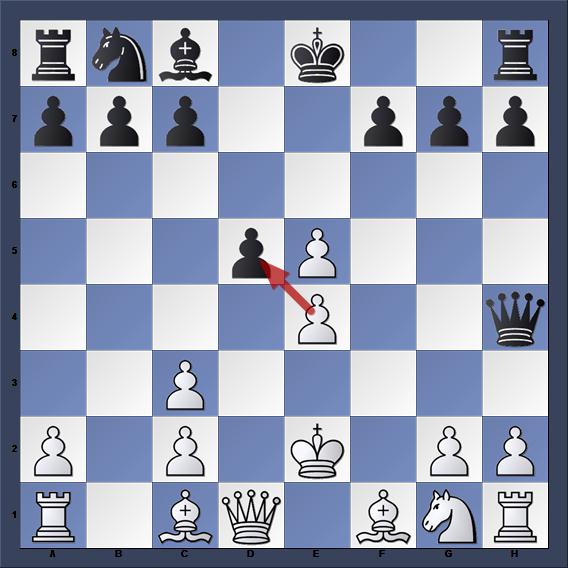
1. e4 e5 2. Nc3 Nf6 3. f4 d5 4. d3 Bb4 5. fxe5 Nxe4 6. dxe4Qh4+ 7. Ke2 Bxc3 8. bxc3

What do you make of black’s enterprising play? Does he have enough for the knight? Whether or not you could win here depends on your ability to exploit the uncomfortable white king. You’ve got to tie the king down, either in the center of the board or an edge; establish a mating net for both the king’s current position and for any possible flight square; lastly find a focal point (the square which will host the lethal check). When you view the rest of this game do it through this lens. Consider the following:

Was the white king safe on his fourth rank? What does it take to really make a king mortally frightened?

Black’s attack didn’t stall but he did leave the white king alone for a while. Why is this? How do you know when it’s appropriate to abandon the monarch for a time? I find it very instructive that black secured the squares around the king, particularly on white’s second rank, before he continued the chase.

Can you see black’s motivation behind the quiet 22. Qg2? It’s not a hammer blow but it does chop off a large chunk of real estate. It really is very difficult, even with a local piece majority, to mate a king on the lam.

The 25th move is the high-water mark for black. How could he have prevented white’s king from finding a haven in the corner? Is it possible that he pursued the king too aggressively?    Is there a time when the king is in the greatest possible danger given the positional considerations at hand? White’s king was a giggling mongoose baiting black into pursuit.

Bg4+ 9. Nf3 dxe4 10 you could check here. Qd4 Bh5 11. Ke3 Bxf3 12. Bb5+ c6 13. gxf3 Qh6+ 14. Kxe4 Qg6+ 15. Ke3 cxb5 16. Ba3 Nc6 17. Qd5 Qxc2 18. Rac1 Qf5 19. Rhe1 Rd8 20. Qxb5 a6 21. Qb1 Qg5+ 22. f4 Qg2 23. Bd6 Qh3+ 24. Ke4 f5+ 25. Kd5 Qg2+ 26. Kc4 b5+ 27. Kd3 Qf3+ 28. Kc2 Qf2+ 29. Kb3 Rc8 30. Rc2 Qty 31. Kb2 Na5 32. Ka1 Qc4 33. e6 Nc6 34. Qd1 h5 35. Rg1 Rh7 36. Rxg7 1-0

The Raw Diet

In the reality of our lives we are much more than any one thing that we do. We may lay bricks under the hot sun by day, but come alive in front of a canvas each night. Every one of us is moonlighting somehow; this dualism is what makes humanity special. A crab crawls across the bottom of the ocean and that’s it. His being is tied up in routine behavior. He would not walk on land even if he could.

Within our “chess lives” what we become is a definable quantity. Our chess identity is more or less a function of what we study. Feeding the machine the right food then is essential. I am giving myself the equivalent of a “raw diet” today. I’m getting back to the basics of chess, principles and simplicity. I won’t pollute my brain by looking at my dragon chess set, it’s back to basics.

1.d4 d5 2.c4 c6 3.Nf3 Nf6 4.Nc3 e6 5.Bg5 h6 6.Bxf6 Qxf6 7.Qb3 Nd7

I’ve selected this as white since I put the queen on b3 in fighting the Grunfeld. This Moscow Semi-Slav sees white without the bishop pair but with decent central control and development. What I realize is that white doesn’t have to win before the endgame just because he could be slightly worse. He’ll need to convert his dynamic advantages into a strategic weakness for black. The burden isn’t such that white has to checkmate black in the opening. This is something that’s easy to miss.

8.g3 dxc4 9.Qxc4 e5 10.O-O-O Be7 11.Ne4 Qf5 12.Qc2 O-O

I rather like the knights in the middle, supported by pieces. Who says you need outposts? G3 and Bg2 work well with the coordination of other pieces. It’s interesting to see how white tries to improve his position. He is comfortable but can lay claim to nothing significant. Korchnoi will have to demonstrate that white can get away with simple play.

13.Kb1 exd4 14.Nxd4 Qa5 15.Bh3 Nf6 16.Bxc8 Raxc8 17.Nxf6+ Bxf6

18.Nf5 Rcd8 19.f4 Rxd1+ 20.Rxd1 Rd8 21.Rxd8+ Bxd8 22.a3 Qd5 23.e4

White has managed to keep a small advantage, and a plan. Despite the worse minor piece his pawn structure is great. Pawn chains get better as they lengthen.

Qd7 24.e5 Be7 25.Kc1 g6 26.Nd6 Bxd6 27.Qd2 Kf8 28.exd6

Ke8 29.Qe3+ Qe6 30.Qxa7 Qe1+ 31.Kc2 Qe2+ 32.Kc3 Qe1+ 33.Kc2

1/2-1/2 Although Korchnoi could not beat Breev but he took no risks. The late Bent Larsen was a master at “playing for two positive results,” a situation where you can’t lose. When you know you can’t lose a position you are better poised to take chances to win it.


The 2012 World Open

I’m taking a little vacation to the City of Brotherly Love. On July 4th, with any luck, I’ll be celebrating my independence from the worst run of chess I’ve ever played. In the spirit of a wonderful holiday, I declare these truths to be self-evident:

1) I need to set aside time to look over tactical puzzles. One hundred per day at Chesstempo.com should be sufficient. I will step up my physical exercise routine as well. Mens sana in corpore sano.

2) I must learn my openings a little deeper. I will refresh my repertoire, plugging holes as needed. I will play top-level openings, leaving pet lines for skittles and blitz.

3) I must study the masters to think like them. Once a week I will dedicate two hours to studying the greats, particularly the middle games in which I will find myself.

4) I will not settle for merely a good move. I will make the best move that I can. The first move that I generate is right only about thirty percent of the time. I don’t like those odds.

5) I will assume that my move is incorrect, and play the devil’s advocate.

6) I will play for initiative when it is appropriate. I will look for an attack when the position calls for it. I will not simply castle or develop a piece when there’s a real possibility of a winning tactic.

7) I will not balk at complications, but welcome the opportunity to gain an advantage in a dynamic position.

8 )  If my opponent has two bishops, and I choose to open the game, I will be darned sure that my initiative is an enduring one.

9) I am playing in a lower section but I will not give anyone the gift of my overconfidence. I play against pieces not people.

10) I will have fun and not play for results. There is no way to determine the future except to prepare successfully. When opportunity knocks be ready with your hat and coat.

Richmond, VA Spring Open

I have just returned from my first tournament in some time; I now know how bears must feel after hibernation, having the world-weary sense that the universe is very different, though its problems inexplicably remain the same. I had not trained or practiced since my last tournament, two months before. Nevertheless I had high hopes. I put in a performance rating I’m not going to brag about; I beat an 800, an 1100, lost out of the opening against a 1600, and fell to a 1550 who was flat-out more energetic.

My first two opponents gave away pieces early on, so the games don’t show a high-level of skill. You know those situations, the one who is down material slowly gets ground down. The player who is up material plays safe moves that limit counter play, eschewing complications.

The game that I lost in the opening is fairly instructive, at least for a while.

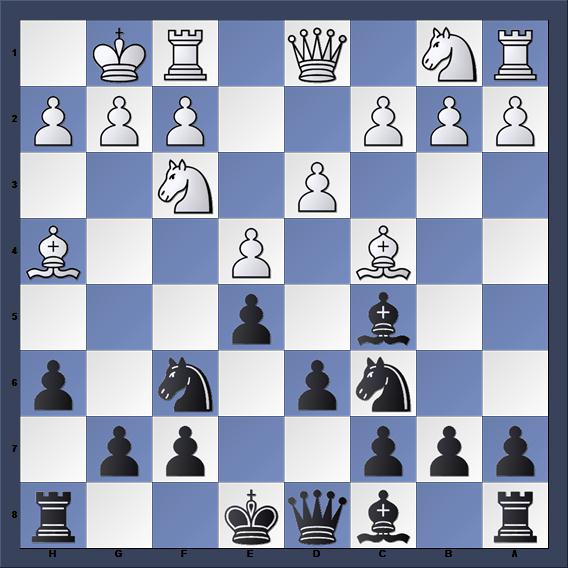
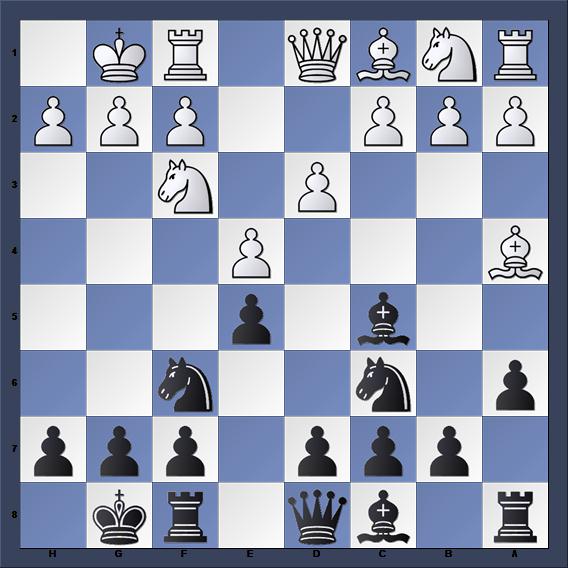
1. e4 e5 2. Nf3 Nc6 3. Bc4 Nf6 4. d3 Bc5 5. Bg5 h6 6. Bh4 d6 7. O-O 7… Na5

Black can play 7. Na5

I like this move. Every time I get this position I want to chase the bishop. Finally I tried it. The knight move gives black a clear plan; by exchanging minor pieces black will try to go to an endgame where the bishop  pair matters. Black has also weakened white’s pawn structure. White has a clear plan too. If he takes too long to get organized his dynamic advantage (better piece development) will come to naught. He needs to play with some pep in his step, but unfortunately it’s hard to see the way forward.

This is a cute way to narrow your opponent’s options. He’s going to create pressure, and all you have to do is defend to be slightly better. If your opponent can’t find an attack he’ll have some weaknesses with which to contend. You no longer bear the burden of trying to win. The onus belongs to white, and if he can’t rise to the occasion you’ll have a fine chess game.

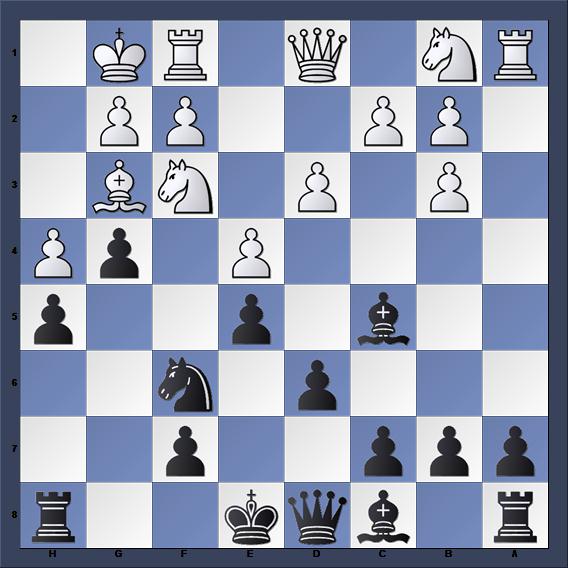
Play may continue in this fashion: 8. Bb3 Nxb3 9. axb3 g5 10. Bg3 h5 11. h4 g4

After 11. g4

Rather than have to wind through the serpentine paths of opening theory it’s better just to play this solid, forcing line. Black will castle long and use rook pressure along the f-file (after f5). Studying this position will be worthwhile. I expect you can navigate to this point quite often.


Scroll to Top